











A pallet display is one of the most practical retail display formats for high-volume products.
It is designed to do two jobs at once. First, it helps move products through shipping and store handling more efficiently. Second, it turns those products into a visible in-store selling unit without requiring full shelf restocking. That is why pallet displays remain common in warehouse clubs, supermarkets, big box retail, and promotional floor zones. Several current industry pages describe pallet displays this way-as retail-ready structures that combine shipping efficiency with high-visibility merchandising.
The problem with many older articles on pallet displays is that they stop too early. They may describe a few shapes, but they do not really help the reader understand which pallet display type suits which retail situation. Your old page does exactly that. It mentions flat, trapezoid, and special-shape pallet displays, but the explanation stays at the appearance level and does not build a full selection framework.
A better guide needs to answer more practical questions. What is a retail pallet display? What is the difference between a full pallet display, a half pallet display, and a quarter pallet display? When does a cardboard pallet display make sense? And what design features matter if the display has to survive real retail handling?
This article answers those questions in a more useful way.
What is a pallet display in retail?
A pallet display is a freestanding retail display built on a pallet base. In many cases, it can be shipped pre-loaded with product and moved directly from the warehouse to the sales floor with limited extra handling. That is one of the reasons pallet displays are so useful in high-volume retail channels. They save time, reduce replenishment work, and create stronger product visibility than ordinary shelf placement.
In practice, a retail pallet display is often used for bulk items, promotional packs, seasonal merchandise, or any product line that benefits from strong floor presence. Pallet displays are especially common in warehouse club environments, mass retail stores, and large-format supermarkets where product volume and traffic are both high.
Many buyers also use related terms like cardboard pallet display, corrugated pallet display, or club store pallet display. These usually refer to the same basic retail idea, with the wording changing based on material, retailer type, or display format.
Why brands use pallet displays
The biggest advantage is visibility.
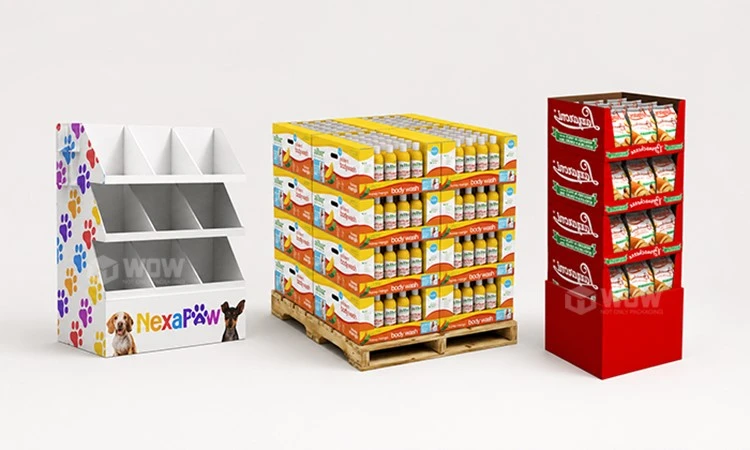
A pallet display sits on the retail floor, not buried inside the regular shelf run. That makes it easier for shoppers to notice. It also gives the brand more room for color, messaging, and product grouping. Creative Displays Now even describes pallet displays as hard to miss in big-box environments because they stand in open space and naturally attract shopper attention between aisles.
The second advantage is volume. Pallet displays are designed to hold more product than many standard cardboard floor displays. That is useful for warehouse retail, club stores, and high-turn promotional campaigns where the display must support both impact and stock depth. Packwins and Smurfit Westrock both position pallet displays as strong solutions for promotions, seasonal merchandise, and high-volume items.
The third advantage is operational efficiency. A good cardboard pallet display can be packed, transported, and placed on the sales floor quickly. Bay Cities specifically highlights this "ready-to-go" benefit, noting that pallet displays can ship already stocked, which reduces the amount of work required at store level.
So, in simple terms, pallet displays are popular because they combine retail presence, stockholding, and easier rollout.
The main types of pallet displays
If you want this page to perform better than the old one, this is the section that matters most.
The older article grouped pallet displays by visible shape: flat, trapezoid, and special-shape. That is not wrong, but it is incomplete. Today, more useful content usually classifies pallet displays by retail footprint and merchandising function, not only by silhouette. Current competitor pages commonly separate pallet displays into full, half, and quarter pallet formats, and sometimes go further into shelved, heavy-duty, and custom versions.
Full pallet display
A full pallet display uses the entire standard pallet footprint. It is best suited to large-volume promotions, high-traffic retail areas, and warehouse-style product movement. Full pallet displays are often used for beverages, paper goods, snacks, club packs, or large promotional bundles. Greendot Packaging describes them as ideal for large-volume promotions or launches, while Landaal lists shelved, heavy-duty, and custom full-pallet options.
This type works well when the brand needs a strong retail block and enough product quantity to support sustained sell-through. It is not subtle. It is built for impact and stock capacity.
Half pallet display
A half pallet display takes up less floor space while still offering more visibility and capacity than a typical floor stand. This format is useful when the retail environment is active but the brand does not need a full pallet footprint. It is often a good compromise between product volume and space efficiency. Competitor pages increasingly position half pallet displays as one of the main retail-ready pallet formats.
Half pallets are practical for medium-volume promotions, secondary placement, and retailers that need more flexibility in aisle planning.
Quarter pallet display
A quarter pallet display is smaller, more compact, and easier to place in tighter retail zones. This type is often used to create product presence without overwhelming the floor plan. It is especially useful for promotional aisles, secondary product groupings, and smaller-format in-store campaigns. Multiple competitor pages now treat quarter pallet display as a major keyword on its own, which tells you buyers are actively searching for it as a distinct retail solution.
Quarter pallet displays are often chosen when the goal is balance: enough scale to look important, but compact enough to fit more retail environments.
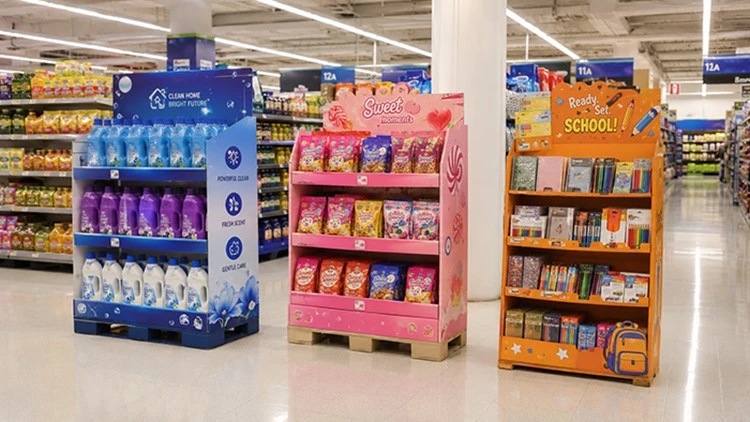
Structural pallet display types: flat, trapezoid, and special shape
Now, your original article's structure logic should still be kept-but reframed.
Flat pallet display
A flat pallet display presents products on a mostly level surface. This is the simplest type and often the easiest to load, stack, and understand visually. It is useful when the products themselves already have strong shelf appeal and only need a visible base and branded wrap to perform better. Your old article describes flat type as products displayed flat on the paper pallet head, which is still a workable starting definition.
This structure is practical for products that do not need extra shape drama. It favors simplicity, loading efficiency, and cleaner product access.
Trapezoid pallet display
A trapezoid pallet display creates a broader top or a tapered body, depending on the design. Your current page describes it as a display where the top and bottom differ in size. That simple shape change matters because it can improve perceived presence and create a more dynamic selling silhouette than a plain vertical block.
This format is useful when the brand wants a little more visual lift without moving into fully custom die-cut complexity.
Special-shape pallet display
Special-shape pallet displays are custom-designed around branding or product theme. Your original article gives examples like dragon boat–shaped dumpling displays, cylindrical cola displays, and cosmetic-themed structures. That direction is valuable and should absolutely be kept, because special-shape displays are where custom cardboard pallet display really starts to differentiate itself.
This type is best used when the campaign needs strong visual identity, seasonal storytelling, or a shape that helps shoppers instantly connect the display to the product or theme.
Cardboard pallet displays vs other retail display types
A pallet display is not the same as every other floor display.
If a standard floor display is about focused vertical selling, a pallet display is more about impact and volume. Your own newer article on the difference between dump bins and pallet displays makes this distinction very clearly: pallet displays are about stronger floor presence and larger product quantity.
Compared with dump bins, pallet displays usually present products more neatly and support more branded structure. Compared with shelf-ready trays, they hold more inventory and create more floor presence. Compared with standard endcaps, they are often more self-contained and easier to move as retail-ready units.
So if the goal is bulk visibility, stronger merchandising footprint, and easier movement from logistics to floor, pallet displays usually make more sense than smaller POS structures.
What makes a good cardboard pallet display?
Not every pallet display performs well just because it is large.
A good corrugated pallet display needs to balance several things at once: structural strength, product access, stockholding, brand visibility, and retailer handling requirements. Packwins and BPKC both emphasize that effective pallet displays need to work as both display units and shipping structures, which means design cannot focus only on appearance.
There are a few practical questions that matter:
Can the display survive transport without collapsing or shifting?
Is the product easy to replenish?
Does the display look clean when some units have sold through?
Is the footprint right for the retailer?
Does the graphics area help the product stand out rather than overwhelm it?
In warehouse and club-store environments, compliance matters too. Newer industry guides increasingly discuss Costco and Walmart pallet display requirements, especially around pallet size, entry access, and structural stability. That does not mean every pallet display article needs to turn into a compliance manual, but it does tell you what more serious buyers care about.
How to choose the right pallet display type
The easiest mistake is choosing by appearance first.
The better approach is to start with the product and the channel.
If the product is bulky, high-volume, or sold in club-store quantities, a full pallet display may be the right choice. If the store needs something more compact but still impactful, a half or quarter pallet display may make more sense. If the campaign is visually themed or highly promotional, then a special-shape cardboard pallet display may do more than a standard rectangular structure.
Then ask the second question: what is the retail goal?
Is the display supposed to move volume? Support a launch? Dominate an aisle zone? Create seasonal excitement? Improve branded presentation in a warehouse-style store?
Once the goal is clear, the display type becomes easier to choose. Without that clarity, pallet display selection tends to become arbitrary.