









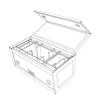



Cardboard display stands are widely used in supermarkets, chain stores, and promotional retail programs because they are lightweight, cost-efficient, and easy to deploy. But in real export projects, the biggest failure point is often not design or production - it is shipping.
A display that looks stable in the factory can arrive with softened board, crushed corners, warped shelves, or damaged locking tabs if the export packing is not designed for moisture, stacking pressure, and long transit conditions. That is why cardboard display shipping should be treated as part of the display project itself, not as a separate step after production.
Why Cardboard Displays Get Damaged in Transit
Transportation is not a neutral process. It introduces a completely different set of conditions compared to production and in-store use.
In a controlled factory environment, cardboard display stands are tested under static conditions. The structure holds weight vertically, joints remain stable, and the material maintains its shape. Once the product enters the logistics chain, those conditions change.
During shipping, displays are exposed to continuous vibration, uneven stacking pressure, and environmental fluctuations. A container traveling across ocean routes can experience weeks of micro-movement. Each vibration may be small, but over time, it affects structural integrity-especially at connection points such as slots, tabs, and glued joints.
Stacking is another major factor. In bulk shipments, cartons are often stacked several layers high. If the packaging is not designed to distribute load properly, the bottom layers absorb excessive pressure. This does not always result in immediate collapse, but it can weaken the structure enough that the display fails during assembly or use.
Humidity adds another layer of complexity. Corrugated cardboard reacts to moisture by softening and losing stiffness. In long-distance sea freight, especially in humid climates, even well-manufactured displays can lose strength before they reach their destination.
This is why transportation should be treated as part of the design process, not as a separate step after production.
What Can Go Wrong During Shipping?

How to Protect Cardboard Displays During Export Shipping
Each of these risks can be addressed through a combination of design adjustments, packaging improvements, and logistics planning.
Optimize Packaging Design for Load Distribution
Packaging is the first layer of protection. A well-designed carton does more than contain the product-it manages how external forces are absorbed and distributed.
Using double-wall cartons increases resistance to vertical pressure. Internal dividers prevent movement inside the box, reducing friction and impact. Edge protection elements reinforce weak points where compression typically occurs.
Packaging should be designed based on shipping conditions, not just product size.
Reinforce Structural Weak Points Before Shipping
Displays should be evaluated not only for retail performance but also for transport stability.
Adding internal support columns can improve vertical strength. Locking mechanisms such as tabs and interlocks provide more reliable connections than adhesive alone. Reinforcing corners and load-bearing shelves ensures that the structure remains stable under stress.
In some cases, temporary reinforcements can be added for shipping and removed during installation.
Control Palletization and Stacking Strategy
Pallet loading directly affects how pressure is distributed across shipments.
Maintaining consistent pallet height prevents excessive load on lower layers. Using uniform stacking patterns ensures that weight is evenly distributed. Stretch wrapping stabilizes the entire pallet and reduces movement during transit.
These adjustments reduce the likelihood of compression damage and improve overall shipment stability.
Select the Appropriate Shipping Method
Choosing the right shipping format has a significant impact on damage risk.
Flat-packed displays are generally safer for large shipments because they minimize exposed surfaces and distribute load more evenly. They also reduce shipping volume and cost.
Pre-assembled displays are more suitable for small-scale or high-end projects where handling can be tightly controlled.
The decision should be based on shipment size, destination, and handling conditions.
Implement Moisture Control Measures
Moisture protection should be integrated into packaging for international shipments.
Sealing displays in protective bags reduces exposure to ambient humidity. Desiccants absorb excess moisture inside cartons. Container liners provide an additional barrier against condensation.
These measures are particularly important for sea freight and humid climates.
Flat Pack vs Assembled Cardboard Displays: Which Is Safer?
The choice between flat pack and assembled shipping is not only about convenience. For cardboard display export packing, it directly affects freight volume, moisture exposure, structural pressure, and the risk of transit damage. In many international shipments, flat pack cardboard displays are safer because they reduce exposed surfaces and distribute load more evenly across the carton.
What Buyers Should Confirm Before Shipping
Many shipping issues originate from missing or incomplete information during the planning stage.
Before production begins, buyers should clearly define:
- Product weight and distribution across shelves
- Overall dimensions of the display
- Shipping method and route
- Environmental conditions at the destination
- Assembly requirements
This information allows manufacturers to adjust both structure and packaging to match real transport conditions.
Final Thoughts
Shipping risks for cardboard display stands are predictable. Moisture, compression, vibration, storage delay, and rough handling all follow patterns that can be planned for early. That is why export packing should be treated as part of the display design system, not as a separate step after production.
For international retail rollout projects, better shipping preparation often makes the difference between a display that arrives ready for store use and one that creates delays before launch.
Common Questions
1.Can paper display stands be shipped internationally?
3.Is sea freight safe for paper display stands?
4.How do I know if my supplier's packaging is good enough?