



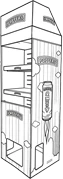





Honeycomb board is often hidden inside a package.
You see the outer carton. You open the box. Somewhere inside, there may be a thick paper panel, a corner protector, or a cushioning insert doing the quiet work. That is how many buyers first understand honeycomb board - as a protective packaging material.
But that is only one side of it.
In display and retail projects, honeycomb board can become something people actually see and use: a paper chair, a display table, a product platform, a pop-up store wall, a seasonal display prop, or a full Honeycomb Display structure for a brand event.
That difference matters.
A material used only inside packaging is judged by protection. A material used in paper furniture or retail displays is judged by structure, appearance, handling, printing, safety, and brand fit. It has to hold weight. It has to look intentional. It has to survive setup and use.
This article looks at the main applications of honeycomb board in paper furniture, protective packaging, and retail displays - and when brands should consider it for their own projects.
What Can Honeycomb Board Be Used For?
Honeycomb board can be used in any project that needs a paper-based material with better panel rigidity than ordinary paperboard.
The most common applications include:
|
Application |
What Honeycomb Board Helps With |
|
Paper furniture |
Lightweight tables, chairs, benches, display seating, temporary furniture |
|
Protective packaging |
Cushioning, edge protection, corner guards, pallet pads, product separators |
|
Retail displays |
Stronger display bases, back panels, product platforms, display walls |
|
Honeycomb Display projects |
Pop-up store structures, brand event displays, eco-themed retail setups |
|
Exhibition spaces |
Temporary walls, display furniture, portable product platforms |
|
Seasonal display props |
Paper trees, decorative structures, themed retail elements |
The appeal is clear. Honeycomb board gives designers thickness without too much weight. It gives brands a paper-based visual language without relying only on thin corrugated cardboard. It also gives packaging teams another option when foam or plastic cushioning feels out of step with the product's sustainability message.
Still, it is not a universal material.
A simple folding counter display may not need honeycomb board. A short-term, low-budget promotion may be better served by corrugated cardboard. But when the project needs a stronger panel, a thicker visual structure, or a more stable paper-based form, honeycomb board starts to make sense.
What Makes Honeycomb Board Suitable for Structural Applications?
Honeycomb board is not just thick paper.
Its strength comes from the internal structure. The board usually has a honeycomb-shaped paper core placed between surface layers. That internal cell structure helps distribute pressure across the panel.
This is why honeycomb board appears in very different applications - packaging inserts, paper furniture panels, retail platforms, and display walls.
The material does not behave exactly like wood, metal, or plastic. It should not be described that way. It is still paper-based. But with the right structure and thickness, honeycomb board can create a surprisingly solid result.
Lightweight Strength from the Honeycomb Core
The honeycomb core gives the board its most useful feature: lightweight rigidity.
Instead of adding weight through a solid panel, honeycomb board creates strength through internal geometry. The hexagonal paper cells create spacing and support between the two outer surfaces. This helps the panel resist bending better than many ordinary flat paperboards.
For B2B buyers, the practical benefit is simple:
- The material can create thick panels without becoming too heavy.
- It can be used in large flat surfaces.
- It can support temporary furniture and display structures.
- It can help protect products during shipping.
- It can reduce the need for heavier rigid materials in some projects.
Some buyers search for terms like honeycomb corrugated board, although honeycomb board and corrugated cardboard are not the same structure. Corrugated cardboard uses fluted paper layers. Honeycomb board uses a honeycomb core. Both are paper-based, but they are better suited to different jobs.
That distinction is important when selecting materials for packaging, furniture, or a Honeycomb Display.
Thick Panels Without Excessive Weight
Retail display projects often need visual thickness.
Thin panels can work for small promotions, but they may look weak in a large retail space. A display wall, a product island, or a paper furniture setup needs more presence. The panels should feel stable, not temporary in a bad way.
Honeycomb board helps here because it provides thickness and stiffness while keeping the structure easier to handle.
That is why honeycomb furniture panels are used in:
- Paper chairs
- Paper tables
- Benches
- Display platforms
- Pop-up store fixtures
- Exhibition furniture
- Temporary retail walls
- Event display structures
For a brand event or showroom installation, this matters. Staff need to move the pieces. The display needs to be assembled without heavy tools. The structure needs to look clean enough for photos, customers, and internal brand teams.
Honeycomb board sits in a useful middle ground: more substantial than thin paperboard, lighter than many solid boards.
Paper-Based Material for Sustainable Brand Presentation
Many brands want materials that match their sustainability message. That does not mean every display must be made from paper, or that paper is always the best answer.
But for certain campaigns, a paper-based structure feels more consistent.
A natural food brand, an eco lifestyle product, a children's activity campaign, or a sustainable home goods brand may not want a display setup that looks overly plastic or industrial. Honeycomb board can support a softer, more natural visual direction.
It can be finished in different ways:
- Kraft paper surface
- Full-color printed paper
- Laminated graphic sheets
- Textured paper wrap
- Exposed honeycomb edge as a design feature
- Covered edge for a cleaner retail finish
The sustainability story still needs care. A display is not sustainable simply because it uses paper. Coatings, glue, lamination, ink, shipping volume, material waste, and local recycling conditions also matter.
A better approach is to ask: does this material reduce unnecessary weight, avoid overbuilt structures, support practical recycling, and fit the brand message?
That is where honeycomb board can be valuable.

Application 1: Honeycomb Board in Paper Furniture
Paper furniture is one of the more interesting uses of honeycomb board because it challenges what many buyers expect from paper materials.
A paper chair? A table? A bench? It sounds fragile until the structure is properly designed.
Paper Chairs, Tables, Benches, and Temporary Seating
Honeycomb board can be used to create lightweight furniture for indoor temporary spaces.
Common furniture types include:
- Paper chairs
- Paper stools
- Paper tables
- Long benches
- Lounge-style seating
- Paper desks
- Product display tables
- Children's activity furniture
- Seasonal decorative furniture
These are not meant to replace all permanent furniture. That would be the wrong expectation.
Paper furniture made from honeycomb board works best in controlled indoor settings where light weight, customization, and visual impact are more important than long-term heavy-duty use.
Why Honeycomb Board Works Well for Paper Furniture
Furniture needs structure first.
A chair is not just a shape. It has to support weight. A table is not just a flat panel. It has to stay stable when people place items on it. A bench has to deal with pressure from different sitting positions.
Honeycomb board works well for paper furniture because it provides:
- Thick panel structure
- Better rigidity than thin paperboard
- Relatively low weight
- Custom shapes
- Printable or kraft-style surface options
- Slotting and interlocking possibilities
- Easy handling for temporary setups
- But load-bearing must never be guessed.
For seating furniture, structure testing is essential. The final strength depends on panel thickness, support direction, joint design, contact area, edge finishing, and user behavior. A paper chair used for children's activity space is not the same as a bench used by adults in an event area.
That is why a proper paper furniture project should go through structural design and prototype testing before production.
The material is only the beginning.
Best Scenarios for Honeycomb Board Paper Furniture
Honeycomb board furniture is most useful when the furniture is part of a visual or brand environment.
For example, a sustainable product launch may use paper tables and stools to reinforce the brand's eco message. A children's event may use lightweight paper furniture because it feels playful and easy to move. A holiday campaign may add decorative paper structures such as a Christmas tree, product stage, or themed seating corner.
Good use cases include:
- Pop-up store furniture
- Exhibition display furniture
- Event seating areas
- Retail photo zones
- Paper desks for temporary spaces
- Brand storytelling installations
- Educational or children's environments
- Seasonal decorative furniture
- Indoor creative office setups
This is where honeycomb board becomes more than a packaging material. It becomes part of the customer experience.
Application 2: Honeycomb Board in Protective Packaging
Packaging is still one of the strongest applications for honeycomb board.
The reason is practical. Some products need more than a standard corrugated carton. They need stronger support, edge protection, cushioning, or internal separation.
Honeycomb board can help protect products while keeping the packaging paper-based.
Heavy Product Protection and Cushioning
Honeycomb board is often used for products that are heavier, fragile, or more exposed to shipping damage.
Examples include:
- Furniture
- Appliances
- Glass products
- Ceramic items
- Electronics
- Lighting products
- Machinery parts
- Large-format retail products
- High-value e-commerce products
In these cases, the packaging has to manage impact, pressure, and movement during transportation.
Honeycomb board can be used as:
- Cushioning panels
- Internal support boards
- Corner protectors
- Edge guards
- Bottom pads
- Top pads
- Separators
- Buffer blocks
It can reduce or replace foam in some packaging structures when properly designed and tested. That last part matters. Foam cannot always be removed without changing the structure. The new paper-based packaging needs to be tested against the product's weight, shape, fragility, and shipping route.
A good honeycomb board packaging solution should protect the product, reduce unnecessary material, and fit the shipping method.
Edge Protection, Corner Guards, and Pallet Layer Pads
Honeycomb board packaging is not always a large flat panel. It can also be converted into smaller protective components.
Common parts include:
- Edge protectors
- Corner guards
- Pallet layer pads
- Product separators
- Internal panels
- Buffer strips
- Top and bottom protection boards
- Protective inserts
- Each part solves a different shipping risk.
Corner guards reduce impact at vulnerable points. Edge protection helps prevent crushing along the product's sides. Layer pads spread pressure when goods are stacked. Internal panels keep products from shifting inside the carton.
For brands shipping fragile or high-value goods, these details can reduce damage claims and replacement costs.
Packaging buyers often focus on the outer box first. That is understandable. But many shipping failures happen inside the box. The internal structure is where honeycomb board can make a real difference.
When Packaging Buyers Should Choose Honeycomb Board
Packaging buyers should consider honeycomb board when:
- The product is heavy
- The product has fragile edges or corners
- Shipping distance is long
- Stacking pressure is high
- Foam reduction is required
- Product damage costs are high
- The carton needs stronger internal support
- A paper-based protective structure is preferred
For light, low-risk products, standard corrugated cardboard may be enough. No need to over-engineer the packaging.
But when transport damage becomes a serious cost, honeycomb board can be a useful packaging material.

Application 3: Honeycomb Board in Retail Displays and Honeycomb Display Projects
A Honeycomb Display is not a single product shape.
It is a display solution that uses honeycomb board in structural areas where ordinary paperboard may feel too thin or weak. This can include bases, side panels, shelves, platforms, back panels, display walls, or event furniture.
The value is not just strength. It is the combination of strength, light weight, thickness, and paper-based presentation.
Honeycomb Display Stands for Stronger Paper-Based Structures
In retail display projects, honeycomb board is often selected when a brand wants a stronger paper-based display without moving to wood, metal, or plastic.
It is suitable for:
- Retail display islands
- Product platforms
- Pop-up displays
- Eco product displays
- Large back panel displays
- Event display structures
- Medium-weight product displays
- Seasonal display installations
- Paper-based showroom fixtures
A Honeycomb Display can be used for products that need a more stable base or thicker visual panels. It can also work well when the brand wants the display to feel more substantial than a standard corrugated cardboard display.
The whole display does not always need to be made from honeycomb board. In many cases, the best design uses honeycomb board only in key structural areas.
That keeps the display practical.
Retail Display Panels, Bases, and Product Platforms
Honeycomb board is especially useful in display parts that need thickness or rigidity.
These include:
- Base panels
- Side panels
- Back panels
- Product platforms
- Display walls
- Thick header boards
- Internal reinforcement panels
For example, a retail platform may use honeycomb board to support product weight and create a clean, thick appearance. A display wall may use honeycomb board because the large panel needs to stay flat. A base may use honeycomb board because the structure needs better stability.
Printed graphics can be applied through mounted sheets, printed paper wrap, or laminated surfaces.
In some projects, a combination works better: honeycomb board for structure, corrugated cardboard for printed display parts. This is especially useful when the display needs both strength and colorful campaign visuals.

Honeycomb Board vs Corrugated Cardboard: Which Application Fits Better?
Honeycomb board and corrugated cardboard are both useful. They simply do different jobs.
|
Application Need |
Better Option |
|
Lightweight printed promotional display |
Corrugated cardboard |
|
Thick paper furniture panels |
Honeycomb board |
|
Heavy protective packaging |
Honeycomb board |
|
Folding retail display shelves |
Corrugated cardboard |
|
Strong display base or platform |
Honeycomb board |
|
Full-color short-term POS display |
Corrugated cardboard |
|
Paper chairs, tables, and benches |
Honeycomb board |
|
Mixed paper-based retail structure |
Combination |
|
Seasonal supermarket dump bin |
Corrugated cardboard |
|
Pop-up display wall or product island |
Honeycomb board |
Corrugated cardboard is usually better for folding, die-cutting, and cost-effective promotional displays. It is also excellent for printed graphics and short campaign cycles.
Honeycomb board is better when the project needs thicker panels, stronger surfaces, and a more rigid paper-based structure.
Many buyers search for "honeycomb corrugated board," but the two structures are different. The best material choice depends on the application, not just the keyword.
What Should Buyers Confirm Before Starting a Honeycomb Board Project?
Before starting a custom honeycomb board project, buyers should answer these questions:
1. Is the project for furniture, packaging, or retail display?
2. What weight does the structure need to support?
3. Will people sit on it, or will it only hold products?
4. How long will it be used?
5. Is it for indoor or outdoor use?
6. Does it need full-color printing?
7. Should the honeycomb edge be visible or covered?
8. Will it be shipped flat-packed or assembled?
9. Does the project require prototype testing?
10. Is sustainability a brand requirement or just a material preference?
11. Will the structure be handled by store staff, event staff, or end users?
12. Does the project need to be reused?
These questions help prevent two common mistakes: over-designing a simple project or under-designing a structure that needs real strength.
For custom Honeycomb Display, honeycomb furniture panels, or protective packaging, early material evaluation saves time later.
Final Thoughts: Honeycomb Board Works Best When Structure and Brand Presentation Matter
Honeycomb board is more versatile than many buyers expect.
It can be used inside packaging to protect products. It can be used in paper furniture to create chairs, tables, benches, and temporary seating. It can be used in Honeycomb Display projects to build stronger paper-based retail structures, display walls, product platforms, and event installations.
Planning a custom Honeycomb Display, paper furniture setup, or protective packaging project? WOW Packaging can help evaluate board thickness, structural design, printing, edge finishing, prototyping, packing method, and production before mass manufacturing.
Send us your product size, usage scene, target weight, display duration, and visual requirements. Our team can help turn the material into a practical structure - not just a good-looking idea.
FAQ
1.What is a Honeycomb Display?
A Honeycomb Display is a retail or event display structure that uses honeycomb board as part of the display's structural design. It may include display stands, display walls, product platforms, paper furniture, pop-up store counters, or seasonal display props.
2.Can honeycomb board be used for paper furniture?
Yes. Honeycomb board can be used for paper chairs, tables, stools, benches, display platforms, and temporary event furniture. For seating or load-bearing furniture, prototype testing is necessary before production.
3.Is honeycomb board strong enough for retail displays?
Honeycomb board can be strong enough for many retail display applications, especially when used for bases, back panels, side panels, product platforms, and large flat panels. Final strength depends on board thickness, structure design, connection method, and product weight.
4.What is the difference between honeycomb board and corrugated cardboard?
Honeycomb board uses a honeycomb-shaped internal core and is better for thick, rigid panels. Corrugated cardboard uses fluted layers and is usually better for folding, die-cutting, printed promotional displays, and cost-sensitive packaging.
5.Can honeycomb board replace foam in packaging?
Honeycomb board can reduce or replace foam in some packaging structures, especially for cushioning, edge protection, corner guards, separators, and pallet pads. The replacement should be tested based on product weight, fragility, and shipping conditions.
6.Can honeycomb board be printed?
Yes. Honeycomb board can be finished with printed paper, laminated graphics, kraft paper, colored paper, or textured surface material. Printing and edge finishing should be planned during the structural design stage.
7.What are honeycomb furniture panels used for?
Honeycomb furniture panels can be used for paper chairs, paper tables, benches, display counters, event furniture, pop-up store furniture, showroom installations, and eco-themed creative spaces.