










Not every paper display stand needs honeycomb board.
For many short-term promotions, a standard corrugated cardboard display stand is already practical enough. It is light, easy to print, cost-friendly, and familiar to most retail teams. But there are projects where a normal cardboard display starts to feel a little too thin, too flexible, or not strong enough for the job.
That is where honeycomb board becomes worth looking at.
Honeycomb board is still a paper-based material, but its internal structure is different. The honeycomb core gives the board better panel rigidity, especially when the display needs thicker side panels, a stronger base, or a more stable structure. For brands that want a display stand with a paper-based look but more strength than a typical corrugated display, honeycomb board can be a smart option.
The key is knowing when to use it - and when not to.
This guide explains when brands should consider honeycomb board for display stands, what it works best for, where it may not be the right choice, and what buyers should confirm before starting a custom display project.
When Should Brands Use Honeycomb Board for Display Stands?
Brands should consider honeycomb board when a display stand needs stronger panels, better stiffness, or a more solid paper-based structure.
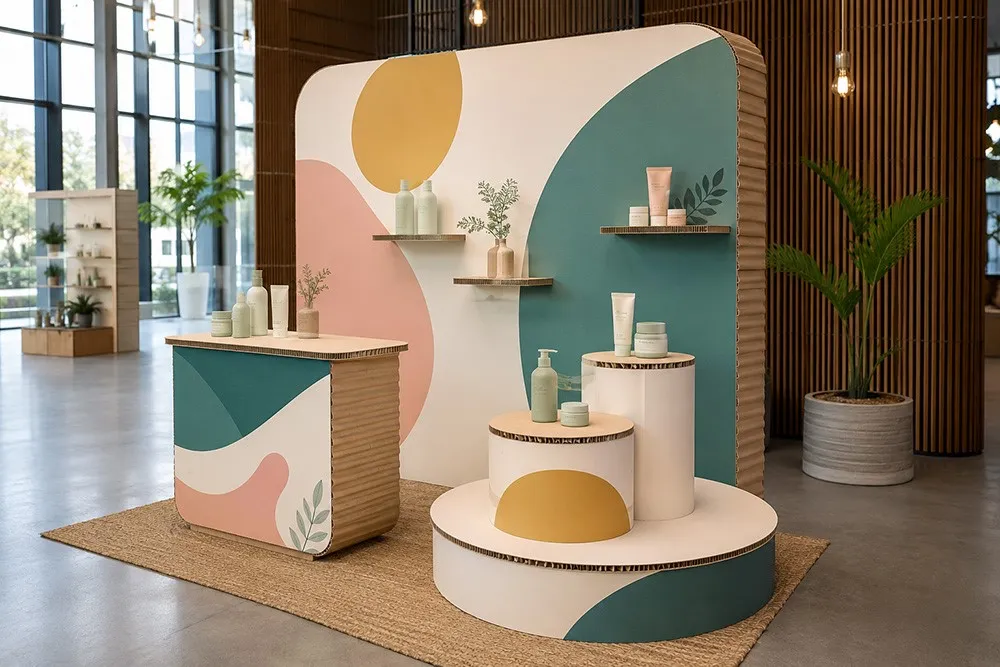
It is especially useful when the display is larger than a normal promotional stand, needs to hold medium-weight products, or has to create a more premium in-store presentation. Honeycomb board can also work well for pop-up displays, event displays, paper furniture, retail display islands, and eco-themed brand campaigns.
Use honeycomb board when:
- The display needs thick side panels or back panels
- The product is medium to heavy
- The display needs a stronger base or platform
- The brand wants a paper-based display with better rigidity
- The structure is used for pop-up retail, exhibitions, or brand events
- Sustainability is part of the brand story
- A standard corrugated cardboard display stand feels too light for the project
But for very short-term, lightweight, low-budget promotions, corrugated cardboard may still be the better material. No need to overbuild a display that only needs to hold small packaged products for a few weeks.
A good display solution is not about choosing the strongest board. It is about choosing the right board.
What Is Honeycomb Board in Display Stand Design?
Honeycomb board is a paper-based structural board with a hexagonal core between surface papers. The inside looks like a honeycomb pattern, which is where the name comes from.
That structure helps spread pressure across the panel. Compared with many standard corrugated boards, honeycomb board can feel thicker and more rigid. It is often used when a project needs a stronger paper panel without moving directly to wood, metal, or plastic.
In display stand design, honeycomb board is usually not selected for folding flexibility. It is selected for panel strength.
How the Honeycomb Core Supports Display Structure
The honeycomb core gives the board internal support. Instead of relying only on a thin fluted layer, the hexagonal paper cells help the panel resist bending and compression.
For retail displays, this matters in several areas:
- Side panels that need to stay straight
- Back panels that need a larger visual surface
- Bases that need to support product weight
- Product platforms that need a flatter, stronger surface
- Paper furniture or display islands used in events
Honeycomb board is not magic. Its strength still depends on thickness, paper grade, edge treatment, glue quality, and the final structure. If the design is poor, even a strong material will not save the display.
But when the structure is properly engineered, honeycomb board can give a paper display stand a more stable and substantial feel.
Where Honeycomb Board Is Usually Used in a Display Stand
Honeycomb board is often used in the parts of a display that need extra support or thickness.
Common areas include:
- Display bases
- Side panels
- Back panels
- Header panels
- Product platforms
- Large flat panels
- Paper furniture parts
- Internal reinforcement sections
In many custom display stand projects, the whole unit does not need to be made from honeycomb board. That would often increase cost and make the structure less flexible.
A more practical approach is to use honeycomb board in key structural areas, then combine it with corrugated cardboard, printed sheets, or other materials where needed. For example, the base and side panels can use honeycomb board, while the printed shelf fronts or graphic panels use corrugated cardboard.
This kind of mixed paper structure can balance strength, cost, printing, and shipping efficiency.
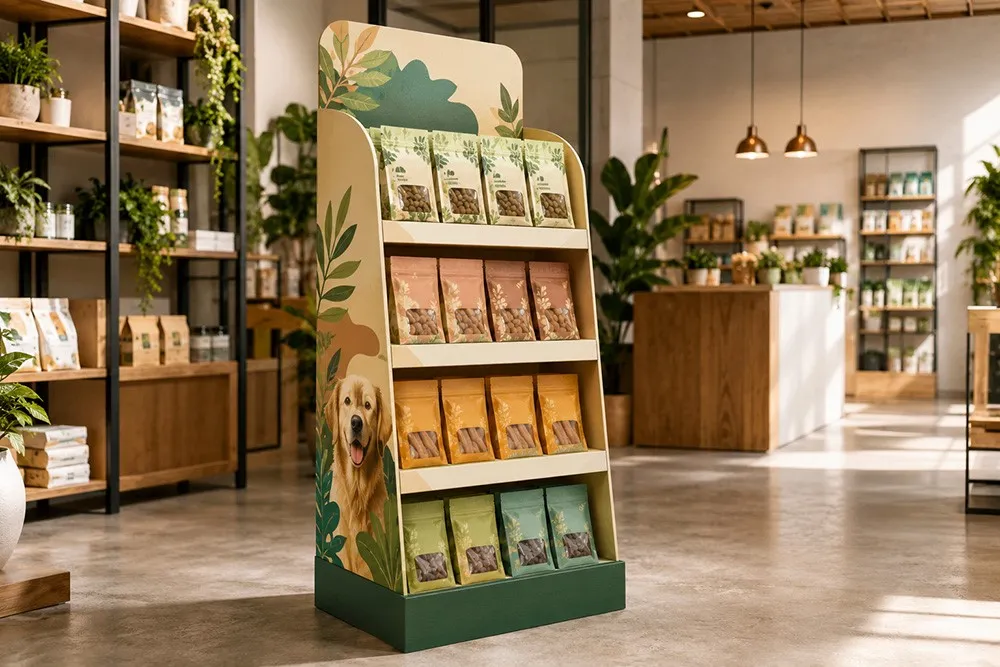
Why Brands Choose Honeycomb Board for Display Stands
Brands usually choose honeycomb board for one of four reasons: strength, appearance, sustainability, or transport efficiency. Sometimes all four.
Stronger Panel Rigidity for Larger Display Structures
Larger display stands need more than a nice graphic.
They need to stand straight. Hold products. Stay stable when shoppers pick up items. Survive packing, shipping, and store-level handling.
Honeycomb board is useful when the display has a wide back panel, thick side panels, or a large base. It can reduce bending and help the whole structure feel more reliable.
This makes it suitable for:
- Large paper display stands
- Retail display islands
- Product platforms
- Paper-based event displays
- Eco retail displays
- Semi-permanent promotional displays
For example, a small candy counter display may not need honeycomb board. A large pet product display, home goods display, or pop-up product platform might.
The product decides the material. Not the other way around.
A Paper-Based Option for More Sustainable Retail Displays
Many brands now want display stands that feel more aligned with their sustainability goals. They may want to reduce plastic, avoid foam, or use more paper-based retail materials.
Honeycomb board can support that direction. It is made from paper and can be used to create strong, lightweight structures for retail display projects.
But this part needs to be said carefully.
A display is not sustainable just because it uses paper. If it uses too much material, difficult coatings, oversized packaging, or unnecessary laminated surfaces, the environmental value becomes weaker.
For a more responsible display solution, buyers should consider:
- Material use
- Printing method
- Surface treatment
- Glue and coating
- Packing size
- Shipping efficiency
- Local recycling conditions
Honeycomb board can be part of a sustainable retail display. It still needs a good design.
Thick Panels for Better Brand Presentation
Sometimes a brand wants a display stand that does not look like a temporary cardboard rack.
Honeycomb board can help create a thicker, more solid paper-based appearance. The display looks more structured. More stable. Less flimsy.
That can be useful for brands in categories such as:
- Organic food
- Pet products
- Home goods
- Natural personal care
- Children's products
- Eco-friendly products
- Gift sets
- Small appliances
A honeycomb board display stand can also be finished with printed paper, kraft paper, laminated graphics, or textured surfaces. The result can still feel natural and paper-based, but with a stronger retail presence.
It is not a luxury fixture like wood or metal. But it can sit in the middle - more substantial than a simple corrugated display, lighter and more eco-oriented than many rigid materials.
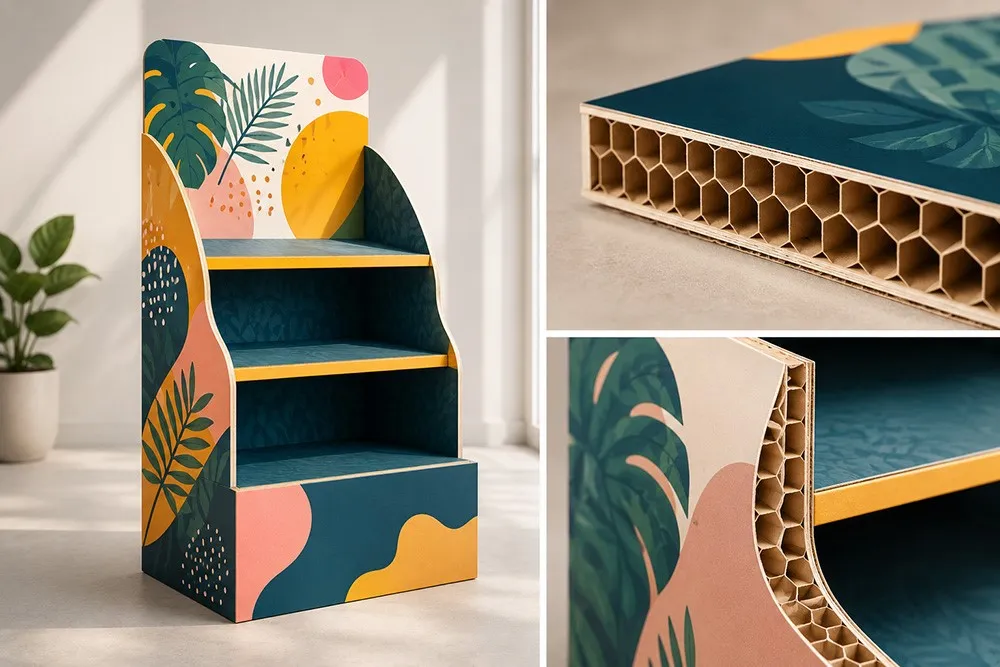
Lightweight Compared with Some Rigid Materials
Honeycomb board is often chosen because it gives structure without adding too much weight.
Compared with some solid boards, wood panels, or metal structures, it can be easier to move, pack, and transport. This matters for event displays, pop-up stores, temporary retail campaigns, and multi-store rollout projects.
A lighter display can reduce handling difficulty. It may also help with store setup, especially when staff need to assemble or move the unit themselves.
Still, light does not mean unlimited strength.
If a display must carry very heavy products for a long period, or if it will be used in a high-humidity environment, a mixed-material structure may be safer. Honeycomb board can be strong, but the full retail environment has to be considered.
When Should Brands Use Honeycomb Board Display Stands?
This is the main question. Below are the situations where honeycomb board becomes more valuable.
When the Display Needs to Hold Medium or Heavier Products
If the product is heavier than snacks, cosmetics, or small boxed items, the display structure needs more attention.
Honeycomb board can be useful for medium-weight products such as:
- Pet supplies
- Bottled products
- Gift boxes
- Home goods
- Small appliances
- Tools
- Toys with heavier packaging
- Health and wellness products
The board itself helps, but structure design is still the real key. Shelf depth, loading direction, base width, support points, and connection method all affect load-bearing performance.
Before mass production, the display should be tested with real product weight. Not an empty sample. Not a visual rendering. The actual product.
That small step prevents many problems later.
When the Display Requires Thick Side Panels or Back Panels
Some displays need thickness for both function and appearance.
Thin panels may work for small promotions, but they can look weak in large retail spaces. Honeycomb board gives designers more room to create thick side panels, larger back panels, stronger header sections, and stable bases.
This is useful when the display needs to create a stronger visual footprint.
For example, a brand display in a specialty store or event space may need to look more like a temporary fixture than a simple paper rack. Honeycomb board gives that extra volume without making the whole display too heavy.
When the Brand Wants a Paper-Based Pop-Up or Event Display
Pop-up stores and events have different requirements from normal supermarket displays.
They need to be eye-catching. Easy to move. Practical to assemble. Strong enough for visitors to interact with. And often, they need to match a brand story.
Honeycomb board can be used for:
- Product platforms
- Paper counters
- Display walls
- Branded backdrops
- Lightweight paper furniture
- Demo tables
- Event display structures
For eco-themed campaigns, it can be a better visual match than plastic or metal. The material itself helps support the message.
But again, usage matters. If the display will travel repeatedly between events or stay in use for many months, the structure may need reinforcement or a mixed-material solution.
When Sustainability Is Part of the Brand Story
For brands that sell natural, organic, eco-friendly, or recyclable products, the display material should not fight the message.
A paper-based display stand can make the retail presentation feel more consistent. Honeycomb board is especially useful when the brand wants a stronger paper structure but still wants to avoid a heavy wooden or metal look.
This can work well for:
- Organic food brands
- Sustainable household products
- Pet care brands
- Natural beauty brands
- Children's products
- Eco lifestyle products
The point is not to say "paper equals green." The point is brand consistency.
If the product talks about natural materials and lower waste, the display should not look overly plastic, heavy, or disconnected from that message.
When a Standard Corrugated Display Does Not Feel Strong Enough
Corrugated cardboard displays are still one of the most practical choices for many retail campaigns. They are excellent for printed graphics, light products, seasonal promotions, and large-volume production.
But sometimes the project needs more.
Honeycomb board becomes useful when:
- The display is larger
- The base needs more stability
- The side panels need more thickness
- The display will stay in store longer
- The product is heavier
- The brand wants a more solid paper-based appearance
In these cases, the best structure may combine both materials. Corrugated cardboard can handle printed and foldable parts. Honeycomb board can support the base, back panel, or reinforcement areas.
That combination often makes more sense than forcing one material to do everything.
When Honeycomb Board May Not Be the Best Choice
A useful article should also say when not to use it.
Honeycomb board is not always the right display material.
For Very Short-Term, Low-Budget Promotions
If the display will only be used for a short campaign and the products are lightweight, corrugated cardboard is usually more efficient.
For example, a simple snack display, small cosmetic counter unit, or supermarket dump bin may not need honeycomb board. The extra material strength may not add enough value.
In this case, a well-designed corrugated cardboard display stand can be easier to produce, print, pack, and distribute.
For Complex Folding or Small Die-Cut Details
Honeycomb board is better for thick panels and stable surfaces. It is not always ideal for designs that need many small folds, tight slots, or detailed die-cut structures.
If the display needs complicated folding, interlocking tabs, or lightweight trays, corrugated cardboard may be more flexible.
Honeycomb board edges also need more planning. Edge finishing, connectors, and assembly details should be designed early, not fixed at the end.
When the Display Needs Frequent Graphic Updates
Some brands update display graphics often. Seasonal campaigns. Monthly promotions. New product packaging. Different store versions.
For those projects, fully printed corrugated panels may be more practical.
Honeycomb board can still work, especially if the structure is designed with removable graphic panels. But that needs to be planned from the start.
A good option is to use honeycomb board as the main structure and change only the printed surface panels when campaigns update.
Honeycomb Board vs Corrugated Cardboard for Display Stands
The comparison is not about which one is better overall. It is about which one fits the project.
| Factor | Honeycomb Board | Corrugated Cardboard |
| Panel rigidity | Better for thick and rigid panels | Better for flexible, foldable structures |
| Printing | Often needs mounted graphics or surface paper | Very common for printed retail displays |
| Best use | Bases, side panels, back panels, paper furniture | Shelves, headers, trays, promotional displays |
| Cost | Usually higher | More cost-flexible |
| Assembly | Needs engineered connectors | Easier for slotting and folding |
| Best project type | Stronger paper-based display | Short-term promotional display |
For many brands, the right answer is not honeycomb board or corrugated cardboard. It is honeycomb board plus corrugated cardboard, used in the correct areas.
How to Design a Better Honeycomb Board Display Stand
Material choice is only one part of the project. A honeycomb board display stand still needs good engineering.
Start with Product Weight and Display Duration
Before choosing the board, buyers should confirm:
- Product size
- Product weight
- Number of SKUs
- Products per shelf
- Display duration
- Store environment
- Shipping method
- Assembly requirement
- Budget range
A display designed only from appearance can fail quickly. The structure has to start from real loading.
Use Honeycomb Board in the Right Structural Areas
Honeycomb board is often most valuable in the base, side panels, back panel, and large display surfaces.
It may not be necessary for every shelf or graphic part.
A practical structure may use:
Honeycomb board for the base
Honeycomb board for thick side panels
Honeycomb board for back panel support
Corrugated cardboard for printed shelves or graphic areas
Mounted printed paper for brand visuals
This keeps the display strong without making it unnecessarily expensive.
Plan Printing, Edge Finishing, and Assembly Early
Honeycomb board display stands need early planning for surface treatment and assembly.
Buyers should confirm:
Will the display use direct print, laminated paper, or mounted graphics?
Do the exposed edges need wrapping?
Will the display be flat-packed?
How will store staff assemble it?
Are connectors needed?
Is a prototype required?
Does the structure need load testing?
These details affect cost, production, packing, and retail execution.
A beautiful display that is difficult to assemble is not a good display.
What Should Buyers Confirm Before Ordering?
Before ordering a custom honeycomb board display stand, buyers should ask:
1. What product will the stand hold?
2. What is the total product weight per shelf?
3. How long will the display be used?
4. Is the display for supermarket, event, pop-up store, or specialty retail?
5. Does it need full-color printing?
6. Does it need a kraft, natural, or premium surface finish?
7. Will it be shipped flat-packed?
8. Will store staff assemble it?
9. Is sustainability part of the requirement?
10. Is prototype testing needed before mass production?
These questions help suppliers recommend a more accurate display structure.
They also help avoid over-designing the display. Or under-designing it, which is worse.
Use Honeycomb Board When Strength, Thickness, and Paper-Based Presentation Matter
Honeycomb board is not the best material for every display stand.
It becomes valuable when a brand needs stronger panel rigidity, thicker paper-based structure, better base support, or a more stable retail presentation. It works especially well for larger display stands, paper furniture, pop-up store displays, event structures, eco-themed retail campaigns, and displays for medium-weight products.
For lightweight, short-term, price-sensitive promotions, corrugated cardboard may still be the better choice.
For projects that need both strong structure and printed brand presentation, a mixed design may work best: honeycomb board for support, corrugated cardboard for printable and foldable areas.
Planning a custom paper-based display stand? Send us your product size, weight, target retail environment, expected display duration, and printing requirements. WOW Packagingcan help evaluate whether honeycomb board, corrugated cardboard, or a mixed paper structure is the better solution for your next retail display project.
FAQ
1.Is honeycomb board strong enough for display stands?
Yes, honeycomb board can be strong enough for many display stand projects, especially when used for thick panels, bases, side panels, and back panels. The final strength depends on board thickness, product weight, loading direction, and structural design.
2.Is honeycomb board better than corrugated cardboard for display stands?
Not always. Honeycomb board is better for rigid panels and stronger paper-based structures. Corrugated cardboard is better for lightweight, foldable, printed, and short-term promotional displays.
3.What products are suitable for honeycomb board display stands?
Honeycomb board display stands can be suitable for pet products, gift boxes, home goods, bottled products, small appliances, tools, eco-friendly products, and event display items. Real product weight should be tested before mass production.
4.Can honeycomb board display stands be printed?
Yes. Honeycomb board can be finished with printed paper, laminated graphics, kraft paper, or mounted surface sheets. Printing and edge finishing should be planned during the design stage.
5.Is honeycomb board eco-friendly?
Honeycomb board is a paper-based material and can support sustainable retail display projects. However, the final environmental value depends on coatings, glue, ink, material usage, packing size, and local recycling conditions.
6.Can honeycomb board and corrugated cardboard be used together?
Yes. This is often a practical solution. Honeycomb board can be used for stronger panels and bases, while corrugated cardboard can be used for printed shelves, graphic areas, foldable parts, and cost-efficient display sections.