










In the fast-paced retail environment, a cardboard display is more than just a canvas for branding; it is a structural engineering project that must withstand the physical demands of the supply chain and the retail floor. For brands moving toward sustainable packaging, the primary challenge is ensuring that cardboard display stands do not succumb to sagging, tilting, or total collapse.
Instability isn't just a logistics failure-it is a brand catastrophe. A display that bows under the weight of inventory or loses its footing in a high-traffic aisle immediately diminishes the perceived value of the product it holds. Achieving high-performance durability requires moving beyond basic "box-making" and into the realm of structural logic.
This comprehensive guide outlines the seven critical pillars of engineering stability and durability into your point of purchase displays.
Choose the Right Cardboard Material
The integrity of any structure is only as strong as its foundation. In the world of corrugated board, "one size fits all" is a dangerous fallacy. Selecting the specific substrate based on load-bearing requirements is the first step toward a successful campaign.
Corrugated Cardboard: The Flute Physics
The "flute"-the arched paper layer between the liners-acts as the vertical column of the display. For standard applications, B-flute is common due to its excellent printing surface. However, for floor-standing units, BE-Flute is often the superior choice. It combines the fine surface of E-flute with the structural rigidity of B-flute, providing a balanced profile that resists crushing while maintaining premium aesthetic appeal.
Double-Wall or Triple-Wall Construction
When weight requirements exceed 15kg per tier, single-wall construction reaches its physical limit.
Double-Wall (e.g., EB or BC Flute): This involves two layers of fluting and three liners. It significantly increases the Edge Crush Test (ECT) rating, allowing custom printed cardboard displays to hold significantly heavier items like beverages or industrial tools without the side walls buckling under vertical pressure.
Triple-Wall: Reserved for industrial-grade pallet displays, triple-wall board provides the strength of wood with the recyclability of paper, capable of supporting hundreds of kilograms.
Moisture-Resistant Options
Cardboard is naturally hygroscopic, meaning it absorbs moisture from the air. In grocery stores or near refrigerated aisles, humidity can soften paper fibers, leading to "creep deformation." To counter this, professional manufacturers utilize water-resistant coatings or film lamination (Gloss or Matt) on the outer liners. This creates a moisture barrier that preserves the material's structural memory even in damp environments.
Reinforce Structural Integrity
Even the highest-grade materials will fail if the internal "skeleton" of the display is poorly designed. Reinforcement is about intelligently directing the path of force from the shelf to the floor.
Support Struts and Beams
To prevent "shelf dip"-the bowing of the horizontal surface-internal support beams are essential.
The Triangle Theory: Incorporating triangular cardboard struts beneath the shelf provides a rigid support that does not deform under pressure. These struts transfer the weight away from the center of the shelf and toward the vertical side panels.
H-Divider Inserts: For deep bins or pallet displays, internal H-dividers act as additional load-bearing walls, preventing the exterior box from bulging outward.
Weight Distribution Physics
Stability is governed by the laws of gravity. A display should be designed to distribute weight evenly across its footprint. If the weight is concentrated in the front, the display will tilt. Engineers use "bridging" techniques in the internal structure to ensure that the load is spread across all four vertical corners of the unit.
Base Stability
The base is the most critical component for preventing tipping. A wider base footprint increases the "Tip Angle" resistance. For narrow displays, adding a weighted base plate or extending the side panels to create a larger surface area on the floor can significantly enhance stability in high-traffic retail zones.
Design with Load-Bearing in Mind
A professional cardboard display supplier designs with the specific product in mind. The shape, weight, and quantity of the inventory must dictate the architectural logic of the stand.
Adjustable Shelves and Load Calculation
Shelves should never be an afterthought. By utilizing "rolled-over" edges-where the cardboard is folded over itself to create a double-thickness leading edge-you can significantly increase the shelf's resistance to bending. If the shelves are adjustable, the interlocking slots must be reinforced to ensure they don't tear under the stress of shifting loads.
Stacking and Alignment
Vertical alignment is key. The "columns" of the display (the side panels) must be perfectly aligned with the base to ensure that the weight of the top shelves doesn't create a "torque" effect that twists the unit. Proper alignment ensures that the force travels in a straight line to the floor, which is the most efficient way to support heavy inventory.
Product Placement: The "Heavy-Bottom" Rule
The center of gravity should always be as low as possible. When designing point of purchase displays, we advise placing 60% of the total weight on the bottom 30% of the unit's height. This "anchoring" effect makes the unit much harder to knock over and reduces the stress on the upper structural joints.
Secure Connections and Joints
Weak joints are the most common cause of "wobble" in retail stands. How the components are joined determines whether the display feels like a solid fixture or a flimsy box.
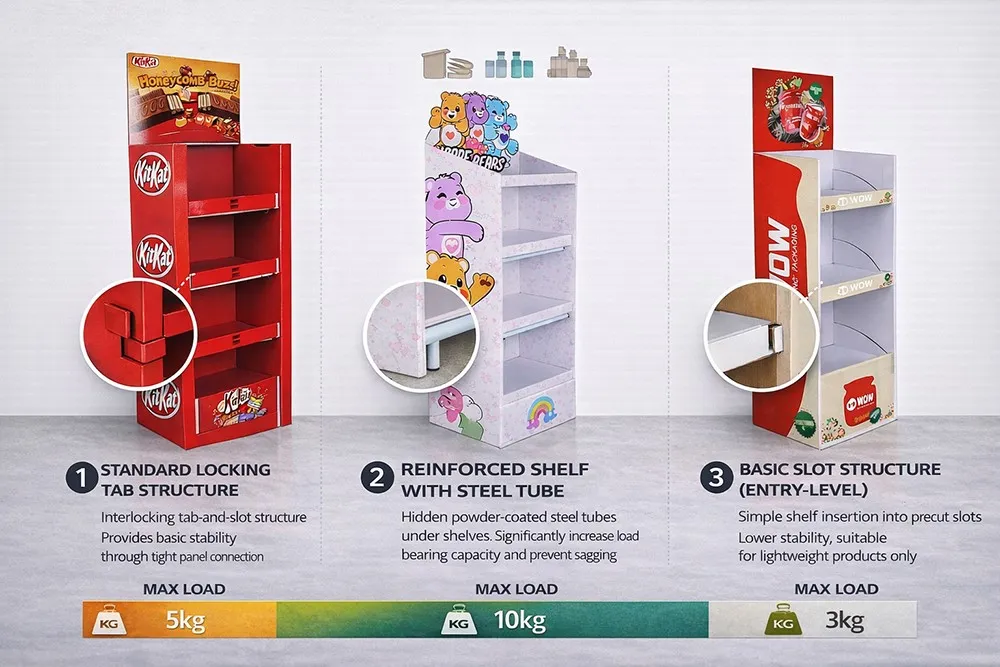
Interlocking Tabs: Mechanical Strength
The best cardboard display stands minimize the use of tape or glue in favor of mechanical interlocking tabs. Tabs that "click" into place create tension within the structure, making it more rigid. "Self-locking" designs use the weight of the product to pull the tabs tighter, meaning the display actually becomes more stable once it is loaded with inventory.
Strong Adhesives
In areas where tabs are not feasible, high-strength industrial adhesives are required. It is vital to use adhesives that are resistant to "cold-flow" (where glue softens in heat) or brittleness in cold-chain environments.
Screws or Clips: The Hybrid Advantage
For semi-permanent displays or extreme loads, paper-based joints can be supplemented with plastic screws or metal clips. These small hybrid additions can extend the life of a display from a few weeks to several months, providing the structural security of a permanent rack with the cost benefits of corrugated board.
Test for Stability and Durability
Theoretical design must be backed by empirical data. Validation through testing is the only way to guarantee field performance.
Weight Tests (Static Loading)
A prototype should be loaded with 1.2x the intended product weight and left for a minimum of 72 hours. This "Safety Margin" test identifies "creep"-the slow bending of material over time. If a shelf bows more than 3mm under this load, the structural engineering must be reinforced.
Drop and Vibration Tests
Retail displays face their greatest stress during transit. Following ISTA (International Safe Transit Association) standards, displays should undergo vibration testing to ensure that interlocking tabs don't shake loose in the back of a truck. Drop tests ensure that if a box is mishandled during unloading, the internal structural components remain intact.
Environmental Testing
To simulate real-world retail, displays are often placed in "humidity chambers." Testing a unit at 80% humidity reveals how the material will behave in coastal regions or near supermarket produce sections, allowing for adjustments in paper grade or coating before mass production.
Consider the Retail Environment
A display that works in a quiet boutique may fail in a high-volume "Club Store" like Costco or Sam's Club.
Traffic Flow and Impact Resistance
In high-traffic aisles, displays are frequently hit by shopping carts and floor scrubbers. To ensure durability, the lower 6 inches of the display can be reinforced with a "scuff sleeve" or a plastic base protector. High-gloss lamination also provides a "slip" surface that allows impacts to slide off rather than tearing the paper fibers.
Floor Surface and Leveling
Retail floors are rarely perfectly level. If a display is placed on an uneven surface, it creates "torsional stress." Designs that include a slightly recessed base can "absorb" minor floor imperfections, keeping the main body of the display plumb and level.
Reusable Displays and Modular Design
For long-term campaigns, modularity is key. By designing a display with replaceable shelves or headers, you can extend the "durable life" of the core structure. If a single shelf is damaged, the staff can replace it without discarding the entire unit, maximizing ROI.
Train Staff on Proper Assembly and Maintenance
Even the most perfectly engineered display will fail if it is assembled incorrectly. The human element is the final piece of the durability puzzle.
Clear, Visual Instructions
Instructions should be graphical and easy to follow. We recommend including a QR code on the shipper box that links to a 60-second assembly video. Correct assembly ensures that every locking tab is fully engaged, which is vital for the unit's structural integrity.
Regular Checks and Maintenance
Retail staff should be trained to perform "integrity audits." Simply pushing the products to the back of the shelf (to maintain the center of gravity) and checking that the base isn't wet can double the lifespan of a custom printed cardboard display.
Repairs and Adjustments
Providing a small "maintenance kit" (such as extra support clips or adhesive strips) for high-value displays allows staff to make minor repairs on-site, preventing a small tear from turning into a structural failure.
FAQ:
Q1: How much weight can a reinforced cardboard display stand hold?
A: With EB-flute material and internal triangular supports, a standard floor unit can hold 15-20kg per shelf. With the addition of hidden metal bars, that capacity can increase to 50kg or more.
Q2: Will humidity make my display collapse?
A: High humidity reduces the stiffness of cardboard. To prevent this, we recommend using a film lamination (Gloss or Matt) which acts as a moisture barrier, and using high-ECT (Edge Crush Test) rated materials for the internal structure.
Q3: Why is my display leaning to one side?
A: This is usually caused by an "asymmetrical load" or a base that isn't perfectly square. Ensure the interlocking tabs in the base are fully engaged and that the product weight is distributed evenly across the width of the shelf.
Conclusion: Engineering for Retail Success
Durability in the retail space is a science of details. From the ECT value of the material to the physics of the triangular support beams, every choice impacts the final performance of the unit. By following these seven pillars, brands can deploy cardboard display stands with the confidence that they will remain stable, professional, and effective until the very last product is sold.
Stability isn't just about holding weight; it's about upholding your brand's reputation on the retail front lines.