












Entering physical retail requires more than a sellable product. Retail buyers assess whether a product can be executed in-store with minimal friction. Custom cardboard displays play a direct role in that evaluation. They show that the brand understands store operations, merchandising rules, and space limitations.
A well-planned cardboard display rack helps a product fit naturally into an existing retail environment. It supports consistent presentation across locations and reduces the workload for store staff. For many retailers, this operational clarity is as important as product margin.
Why Retailers Pay Attention to Display Readiness
Retail displays influence how products are launched, positioned, and maintained in stores. Cardboard shop displays are widely used because they balance visibility, flexibility, and cost control.
From a retail perspective, cardboard retail display stands offer practical advantages:
* Products arrive pre-organized and ready to place
* Display formats are easy to move or remove during resets
* Temporary promotions do not require permanent fixtures
* Store staff follow a clear presentation structure
For new or lesser-known brands, a cardboard point of sale display creates a defined selling space outside standard shelving. This increases exposure without disrupting existing planograms.
Retailers also evaluate whether a display complies with internal standards, including footprint size, stability, and safety. Displays that meet these expectations reduce approval time and simplify rollout decisions.
Common Cardboard Display Formats Used in Large Stores
Large retail chains rely on several established display structures. Each format supports a specific merchandising purpose.
End-of-aisle displays increase visibility in high-traffic zones and are often used for seasonal or promotional products.
Dump bins allow bulk placement and flexible positioning. They are typically used for packaged goods and short-term price-driven promotions.
Sidekick displays attach to shelving and support add-on sales. Their compact size makes them suitable for narrow aisles.
Countertop displays are positioned near checkout areas. These cardboard shelf stand designs support impulse purchases and fast-moving items.
Inline displays sit directly on shelves and are usually pre-packed. They reduce handling time and ensure consistent presentation.
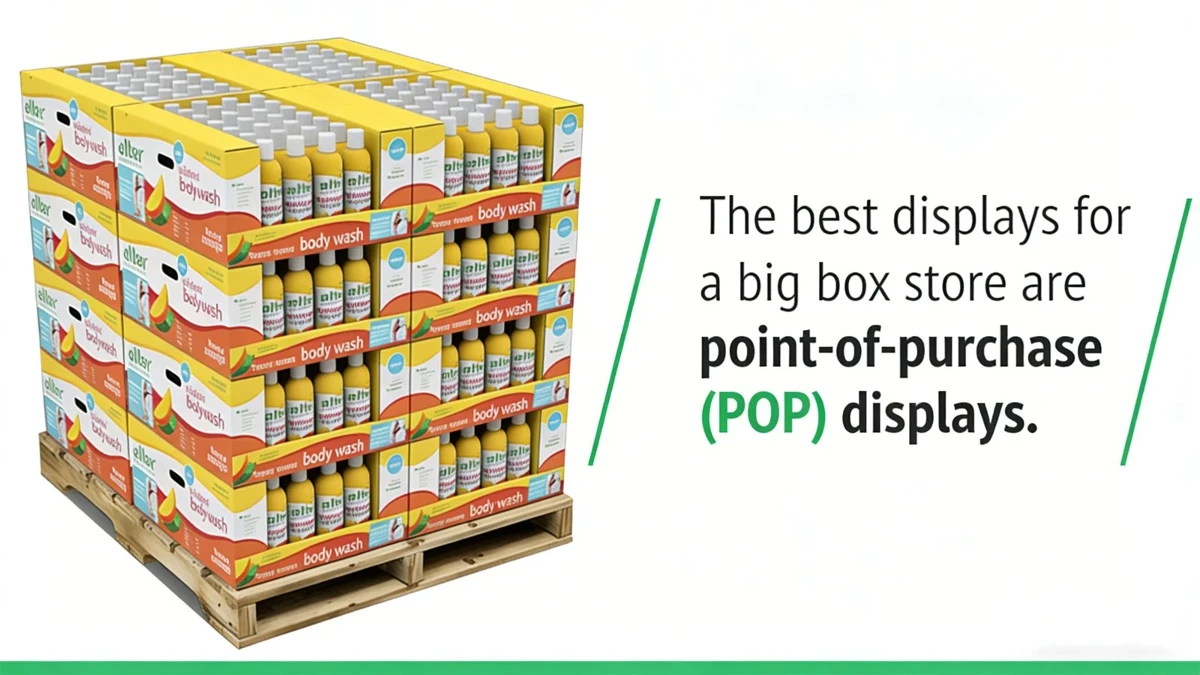
Pallet displays allow large quantities to be placed directly on the sales floor. They are common in warehouse-style retail and promotional events.
Freestanding floor units position products at eye level and operate independently from store fixtures. These are often used for brand-focused campaigns.
Each format is selected based on store layout, product type, and promotion duration.
The Role of a Cardboard Display Supplier
Retail programs involve specific operational requirements. These include load capacity, transport stability, assembly time, and material standards. A qualified cardboard display supplier understands how these factors affect store execution.
At the production level, structural design determines performance. Locking systems, weight distribution, and material thickness influence stability during transport and use.
A reliable cardboard display factory supports the process from structural development to mass production. This includes sampling, testing, and adjustment based on retailer feedback.
Consistency across production batches is critical. Retailers expect uniform appearance and performance across all locations. Variations can lead to store-level rejection or removal.
Supporting Retail Launches With Cardboard Displays
Custom cardboard display racks help brands transition from product development to retail execution. They provide a clear plan for in-store presentation and reduce uncertainty for buyers and store teams.
Cardboard displays are widely used because they adapt to changing retail needs. They support new launches, seasonal promotions, and regional tests without long-term commitments.
When display design is aligned with retail standards, products move from warehouse to sales floor more efficiently. This improves launch timing and maintains consistency across stores.
For brands preparing to enter or expand in physical retail, display readiness is part of commercial credibility. A well-designed cardboard display is not an accessory. It is part of the retail offer itself.
Frequently Asked Questions
1. Why do retailers prefer cardboard displays for new product launches?
Retailers often choose cardboard displays because they are easy to place, move, and remove without changing permanent store fixtures. Cardboard display racks arrive pre-organized, reduce setup time for store staff, and support temporary promotions or test programs without long-term commitment. This flexibility makes them suitable for new product introductions and seasonal campaigns.
2. What factors do retailers evaluate when approving a cardboard point of sale display?
Retailers typically review footprint size, structural stability, safety, and ease of handling. They also consider whether the display fits existing store layouts and operational workflows. Displays that meet these requirements help reduce store-level friction and speed up approval for rollout.
3. How do different cardboard display formats serve different merchandising goals?
Each display format supports a specific function. End-of-aisle and pallet displays increase visibility in high-traffic areas. Countertop and inline displays encourage impulse purchases near checkout or on shelves. Sidekick displays support add-on sales, while freestanding floor units allow independent brand presentation without relying on shelving space.
4. What is the role of a cardboard display supplier in retail execution?
A cardboard display supplier is responsible for more than visual design. The supplier ensures structural performance, transport stability, material consistency, and compliance with retailer standards. This includes sampling, testing, and maintaining uniform quality across production batches to avoid store-level rejection.
5. How do cardboard retail display stands support efficient in-store operations?
Cardboard retail display stands simplify in-store execution by providing a clear presentation structure. Products arrive ready to place, require minimal assembly, and follow a consistent layout across locations. This reduces labor time for store staff and helps maintain uniform product presentation throughout the retail program.