










When brands start looking for paper-based materials for displays or packaging, corrugated cardboard and honeycomb board often appear in the same conversation.
Both are lightweight. Both are recyclable in many applications. Both can be used for retail displays, shipping protection, and custom packaging structures. But they do not solve the same problem.
Corrugated cardboard is usually chosen for printed retail displays, folding structures, shipping cartons, and cost-effective promotional packaging. Honeycomb board is better suited for thicker panels, stronger cushioning, paper furniture, large display structures, and heavier protective packaging.
So which one is better?
The honest answer: it depends on what the material needs to do.
If the project is a short-term supermarket promotion, corrugated cardboard may be the more practical choice. If the goal is to protect a heavy product during transport or create a thick, rigid paper-based panel, honeycomb board may perform better.
This guide compares both materials from a display and packaging perspective, including strength, printing, cost, sustainability, shipping, and real retail use.
Quick Answer: Which Material Should You Choose?
If you need a simple starting point, here it is.
Use corrugated cardboard when your project needs:
- Printed retail displays
- Lightweight to medium product display
- Folding cartons
- Shipping boxes
- Flat-pack display structures
- Seasonal or short-term promotional displays
- Cost-effective production for larger quantities
Use honeycomb board when your project needs:
- Higher panel rigidity
- Heavy-duty protective packaging
- Thick paper-based panels
- Paper furniture
- Large display back panels
- Cushioning for fragile or heavy products
- A stronger paper alternative to some foam or plastic protection
In some projects, the best answer is not one material or the other. A mixed structure can work better. For example, a retail display may use corrugated cardboard for printed shelves and graphic panels, while honeycomb board is used in the base or side panels for extra strength.
|
Project Need |
Better Choice |
|
Printed retail display |
Corrugated cardboard |
|
Lightweight product packaging |
Corrugated cardboard |
|
Heavy-duty protective packaging |
Honeycomb board |
|
Paper furniture |
Honeycomb board |
|
Temporary supermarket display |
Corrugated cardboard |
|
Thick rigid display panel |
Honeycomb board |
|
Display plus packaging support |
Combined structure |
That is why material selection should always start with the product, not the material name.
What Is Corrugated Cardboard?
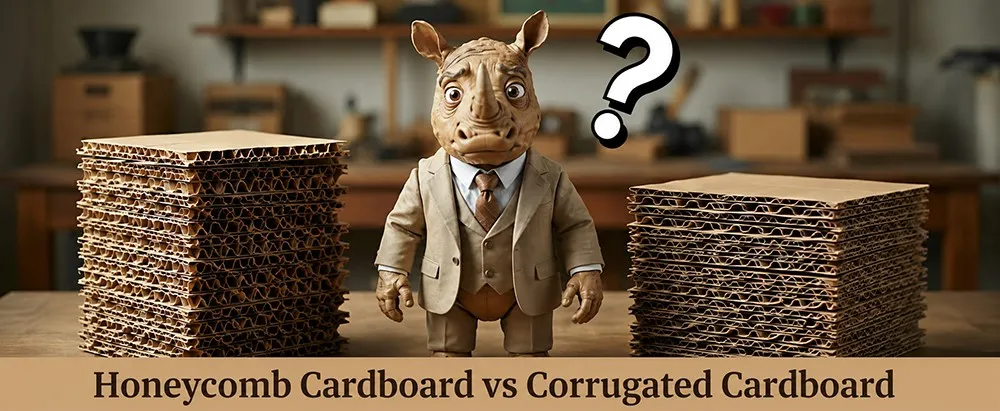
Corrugated cardboard is one of the most common paper-based materials used in packaging and retail displays. It is made with a fluted paper layer placed between linerboards. That wavy inner layer gives the board cushioning, stiffness, and compression resistance while keeping the material relatively light.
For most buyers, the important point is simple: corrugated cardboard is easy to cut, fold, print, ship, and assemble.
That is why it is widely used for cardboard display stands, counter displays, floor displays, shipping cartons, and printed retail packaging.
How Corrugated Cardboard Is Structured
A basic corrugated sheet includes:
- An outer liner
- A fluted middle layer
- An inner liner
The flute is what gives corrugated cardboard its structure. Different flute types affect thickness, strength, surface smoothness, and folding performance. For example, some flutes are better for printing, while others are better for cushioning or stacking strength.
In retail display projects, the board structure matters because the display needs to look good and hold products at the same time. A display with weak shelves may bend. A display with the wrong surface may not print cleanly. A display with poor folding design may become difficult for store staff to assemble.
That is why corrugated cardboard should not be selected only by thickness. The flute type, paper grade, loading direction, shelf design, and assembly method all affect final performance.
Common Uses of Corrugated Cardboard in Displays and Packaging
Corrugated cardboard works especially well for retail and promotional projects where printing, cost control, and flexible structure are important.
Common applications include:
- Cardboard display stands
- Counter display units
- Floor standing display units
- Sidekick displays
- Dump bin displays
- Pallet displays
- Shipping boxes
- Retail packaging boxes
- Promotional packaging
- E-commerce packaging
For example, a snack brand may use a corrugated cardboard floor display for a short supermarket campaign. A cosmetics brand may use a small counter display for new product testing. A toy brand may use a printed dump bin to hold lightweight packaged products near the checkout area.
Corrugated cardboard is not only a packaging material. In retail marketing, it is often a practical selling tool.
What Is Honeycomb Board?
Honeycomb board is also a paper-based material, but its internal structure is different from corrugated cardboard. Instead of a fluted layer, honeycomb board uses a hexagonal paper core between surface papers.
This honeycomb core helps spread pressure across the panel. That is why honeycomb board can feel more rigid, especially when used in thicker panels.
It is often used where lightweight structure and strength are both required.
Why Honeycomb Board Has Strong Panel Rigidity
The honeycomb core works a little like the structure inside an aircraft panel or a lightweight door panel. It creates internal support without making the board extremely heavy.
For packaging and display projects, this means honeycomb board can be useful when the structure needs:
- Better compression resistance
- A thicker panel appearance
- More stiffness across a large surface
- Cushioning for heavy or fragile products
- A lightweight paper-based alternative to some plastic or foam protection
However, honeycomb board is not automatically the best choice for every project.
Its final performance still depends on board thickness, paper quality, edge protection, bonding, surface treatment, and structural engineering. If the edges are exposed, the panel may need extra finishing. If the display needs many folds or slots, corrugated cardboard may still be easier to work with.
Honeycomb board is strong, but it still needs good design.
Common Uses of Honeycomb Board in Packaging, Displays, and Paper Furniture
Honeycomb board is often used in applications that require thicker panels or stronger protective structures.
Common uses include:
- Protective packaging
- Appliance packaging
- Furniture packaging
- Paper furniture
- Large display panels
- Exhibition display structures
- Pallet layer pads
- Corner protection
- Edge protection
- Internal cushioning
- Large signage backing
For example, a furniture product may need honeycomb board panels inside the outer carton to reduce corner damage. A pop-up retail project may use honeycomb board for lightweight paper furniture. A large display structure may use honeycomb board for a thick back panel or base panel where stiffness matters more than folding flexibility.
It is especially useful when a buyer wants a paper-based material but still needs stronger support.
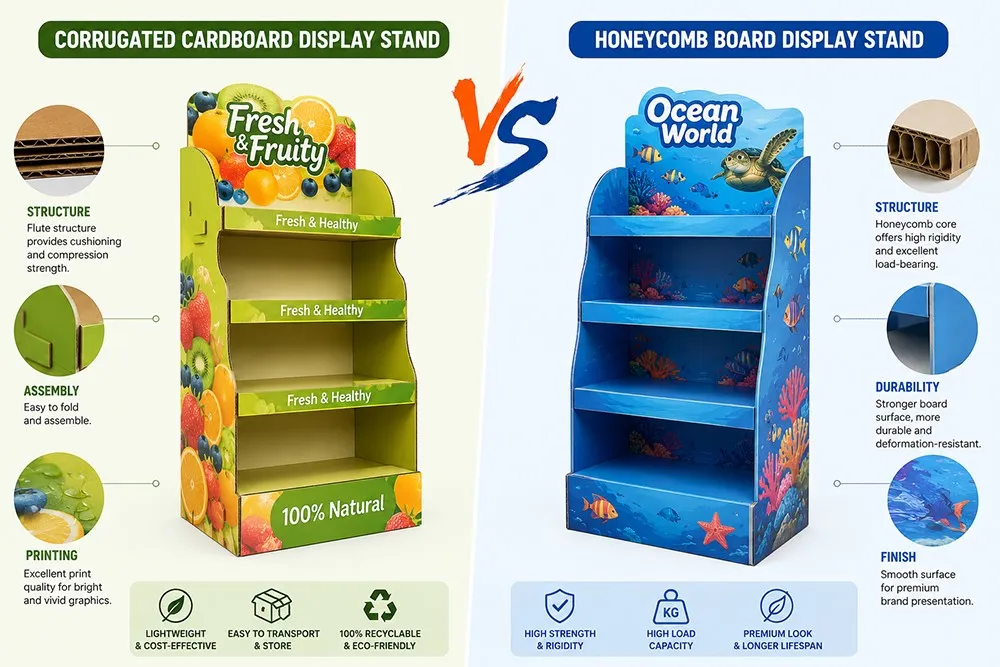
Corrugated Cardboard vs Honeycomb Board: Main Differences
The biggest mistake buyers make is comparing these two materials only by price or thickness.
A better comparison should include strength, printing, assembly, shipping, sustainability, and final use.
Strength and Load-Bearing Capacity
Honeycomb board usually performs better when the project needs thick panel rigidity or stronger compression resistance. Its internal honeycomb core spreads pressure across the board, which makes it suitable for protective packaging, paper furniture, and large flat display panels.
Corrugated cardboard can also hold products well, but it is usually better for light to medium display applications. A properly engineered corrugated cardboard display can support packaged snacks, cosmetics, toys, beverage bottles, small electronics, and other retail products.
The key phrase here is properly engineered.
A weak corrugated display may fail. A poorly designed honeycomb structure may also fail. Material alone does not decide load-bearing performance. The shelf angle, support points, product weight, board direction, glue area, locking tabs, and base design all matter.
For a small counter display holding lightweight products, corrugated cardboard may be more than enough. For a large paper furniture piece or heavy-duty protective packaging, honeycomb board may be the safer choice.
Thickness and Structural Appearance
Corrugated cardboard is easier to fold, slot, cut, and form into display shapes. It is a good choice for displays that need shelves, headers, side panels, trays, hooks, and flat-pack assembly.
Honeycomb board is better when the design needs a thick, flat, rigid panel. It can create a stronger visual presence, especially in large structures. It also gives the display or packaging a more solid panel feel.
This difference matters in retail.
A temporary chocolate display does not always need a thick panel. It needs clean printing, easy setup, and good shelf layout. A large paper-based display wall, however, may need a thicker and more stable structure.
So the question is not "which board is thicker?"
The better question is: what kind of structure does the project need?
Printing and Brand Presentation
Corrugated cardboard is widely used for printed retail displays because it works well with branded graphics, laminated sheets, direct printing, and die-cut shapes.
For point of purchase displays, this is a major advantage. Brands often need bright colors, product images, campaign messages, and clear shelf communication. Corrugated cardboard can support those needs while keeping the structure lightweight and cost-efficient.
Honeycomb board can also be printed or covered with printed sheets, but the surface treatment needs more attention. Depending on the project, honeycomb board may require mounting, lamination, or an additional printed surface layer to achieve the right visual effect.
If the display depends heavily on full-color graphics, corrugated cardboard is usually easier to manage. If the project needs thick rigid panels and premium paper-based structure, honeycomb board with mounted graphics can be a good option.
The printing decision should match the retail purpose.
A display used for a two-week supermarket promotion may need bold graphics more than thick panels. A paper furniture setup for a pop-up event may need structural presence first, then branded surface finishing.
Cutting, Folding, and Assembly
Corrugated cardboard is usually more flexible for production. It can be die-cut, folded, slotted, glued, and packed flat. This makes it practical for large-volume retail display programs.
That is one reason corrugated cardboard displays are common in supermarkets, chain stores, convenience stores, and promotional retail spaces. They can be produced in quantity, shipped efficiently, and assembled at store level.
Honeycomb board is different. It works better as a rigid panel material. It may require more planning for edges, connectors, grooves, support frames, and joining methods.
This is not a weakness. It simply means the design process is different.
For display projects, assembly matters as much as material strength. A board may be strong, but if store staff cannot assemble the display quickly, the project can still fail at retail level.
A good display material should support both engineering and execution.
Shipping and Protective Performance
Corrugated cardboard is the standard choice for many shipping boxes and retail packaging boxes. It provides a strong balance of cost, printability, protection, and production efficiency.
It is especially suitable for:
- E-commerce packaging
- Retail cartons
- Subscription boxes
- Printed outer boxes
- Lightweight shipping cartons
- Product packaging with moderate protection needs
Honeycomb board is more suitable when the packaging needs higher protection. It is often used as inner cushioning, corner protection, layer pads, or panel support for heavier products.
This can include:
- Furniture
- Appliances
- Fragile goods
- Large-format products
- Heavy retail items
- Products with high damage risk during transport
Shipping cost should not be judged by material weight alone. A poor structure can increase product damage. An oversized package can increase freight cost. A non-foldable design can waste container space.
Good packaging should protect the product without adding unnecessary volume or material.
Cost and Production Efficiency
Corrugated cardboard is generally more cost-flexible for printed retail displays and packaging boxes. It is easier to process, easier to fold, and suitable for high-volume production.
That makes it a strong choice for seasonal promotions, supermarket displays, retail packaging, and campaign-based displays where budget control is important.
Honeycomb board may cost more in material handling or processing, especially when edge finishing, mounting, or special connectors are required. But in some protective packaging projects, it may reduce damage risk and help avoid product replacement costs.
So buyers should not only ask:
>Which material is cheaper?
A better question is:
> Which structure gives the best total project cost?
Total project cost includes:
- Material cost
- Printing cost
- Tooling cost
- Assembly time
- Packing method
- Freight volume
- Damage risk
- Store setup efficiency
- Replacement cost
A low material price is not always a lower project cost.
Sustainability and Recyclability
Both corrugated cardboard and honeycomb board can support paper-based, recyclable packaging strategies.
Corrugated cardboard has mature recycling channels in many markets. It is also widely accepted for shipping cartons, retail displays, and packaging boxes.
Honeycomb board can help reduce the use of foam, plastic cushioning, or heavy protective materials in some applications. For brands trying to move toward more paper-based packaging, that can be valuable.
Still, sustainability should be judged carefully.
A paper-based material is not automatically sustainable if the final packaging uses too much material, difficult-to-separate coatings, excessive lamination, or oversized structures. Ink, glue, film, shipping volume, and local recycling conditions also matter.
The most sustainable solution is usually the one that uses the right amount of material, protects the product properly, reduces waste, and remains practical for recycling.
Which Material Is Better for Retail Displays?
Retail displays are not only about holding products. They also need to attract shoppers, communicate the brand, fit store space, survive handling, and stay practical for setup.
That is why the best material depends on how the display will be used.
When Corrugated Cardboard Works Better for Retail Displays
Corrugated cardboard is usually the better choice for temporary and promotional display programs.
It works well for:
- Supermarket promotions
- Seasonal campaigns
- New product launches
- Lightweight product displays
- Floor displays
- Counter displays
- Dump bins
- Sidekick displays
- Point of purchase displays
- Point of sale displays
Its biggest advantages are printing, flexibility, and cost control.
A corrugated cardboard display can be designed with strong visual graphics, product trays, shelves, headers, side panels, and brand messages. It can also be shipped flat and assembled in the store.
For many FMCG, snack, beverage, toy, cosmetic, and personal care products, corrugated cardboard offers the right balance between structure and marketing impact.
It is not the most rigid paper material, but it is often the most practical display material.
When Honeycomb Board Works Better for Retail Displays
Honeycomb board is better for displays that need stronger panels, thicker structures, or a more rigid paper-based form.
It can be useful for:
- Large display back panels
- Paper furniture
- Pop-up store structures
- Exhibition display elements
- Thick side panels
- Product island structures
- Stronger display bases
- Sustainable display installations
For example, if a brand wants a lightweight paper-based table, seating unit, product platform, or thick display panel for an event, honeycomb board may perform better than standard corrugated cardboard.
However, honeycomb board is not always the best choice for every retail display.
If the design requires many folds, small slots, complex die-cut details, or frequent campaign graphics, corrugated cardboard may be easier and more cost-effective.
Honeycomb board is best when rigidity and panel strength matter more than folding flexibility.
When a Mixed Paper Material Structure Works Better
In real custom display projects, the best solution is often a combination.
A display can use corrugated cardboard for printed graphic areas, shelves, trays, and foldable parts. Honeycomb board can be used for the base, side panels, back panel, or reinforcement zones.
This approach can help balance:
- Cost
- Strength
- Print quality
- Shipping efficiency
- Product weight
- Store assembly
- Brand presentation
For example, a retail display for heavier products may use corrugated printed panels for visual branding and honeycomb board inside the base for added support. A pop-up display may use honeycomb board for thick structural panels and corrugated parts for replaceable campaign graphics.
Material selection should follow the product and the retail environment. Not the other way around.
Which Material Is Better for Packaging?
Packaging has a different job from display. A retail display needs to sell. Packaging needs to protect, present, transport, and sometimes support the unboxing experience.
Corrugated cardboard and honeycomb board can both be useful, but they are usually used in different packaging roles.
Corrugated Cardboard for Retail and Shipping Packaging
Corrugated cardboard is one of the most practical materials for retail and shipping packaging.
It is commonly used for:
Shipping cartons
Retail packaging boxes
E-commerce boxes
Subscription boxes
Product outer cartons
Printed packaging boxes
Promotional packaging sets
It is popular because it provides a good balance of protection, printability, cost, and production speed.
For many products, corrugated cardboard gives enough cushioning and stacking strength while still allowing branded printing. It can also be folded and packed efficiently, which helps reduce storage and transportation issues.
If the product is not extremely heavy or fragile, corrugated cardboard is often the first material to consider.
Honeycomb Board for Protective Packaging
Honeycomb board is stronger in protective packaging applications where standard corrugated cardboard may not be enough.
It is often used for:
- Furniture packaging
- Appliance packaging
- Heavy product protection
- Fragile item protection
- Corner guards
- Edge protection
- Internal cushioning
- Pallet layer pads
- Large panel protection
Honeycomb board can help absorb impact and distribute pressure. It can also be used as a paper-based alternative to some foam or plastic cushioning structures.
For products that may be damaged by edge impact, stacking pressure, vibration, or long-distance shipping, honeycomb board may add useful protection.
Again, the design is important. Honeycomb board performs best when the thickness, contact area, fixing method, and outer carton structure are planned correctly.
Combining Printed Packaging and Protective Inserts
Many packaging projects do not need to choose only one material.
A common approach is to use corrugated cardboard as the printed outer box and honeycomb board as the internal protective insert.
This can work well for:
High-value products
Fragile goods
Large items
E-commerce products with higher damage risk
Premium retail packaging that still needs real transport protection
The corrugated outer box carries the branding and shipping function. The honeycomb insert supports the product and reduces movement inside the box.
This combination is useful when the packaging needs both visual presentation and protective performance.
How to Choose the Right Material for Your Project
Choosing between corrugated cardboard and honeycomb board should start with a few practical questions.
Questions Buyers Should Ask Before Choosing
Before selecting the material, answer these questions:
1. What is the product weight?
Heavier products may need stronger shelves, thicker panels, or reinforced packaging.
2. Is the project for display, packaging, or both?
A display structure and a shipping structure have different priorities.
3. How long will the display or packaging be used?
A two-week promotion does not need the same structure as a semi-permanent setup.
4. Does the project require full-color printing?
If graphics are the main selling tool, surface quality and printing method become important.
5. Will the display be shipped flat-packed?
Flat-pack design can reduce freight cost and simplify storage.
6. How far will the product be transported?
Long-distance shipping may require better cushioning and compression resistance.
7. Does the product need edge or corner protection?
Honeycomb board may be useful for products with high corner damage risk.
8. Will store staff assemble the display?
A display that is too complicated may fail during rollout.
9. Is sustainability a key requirement?
The whole structure, not just the board name, should support that goal.
10. What is the target budget and order quantity?
Material choice should match production volume and project value.
These questions help narrow the choice quickly. They also help the display or packaging supplier recommend a more accurate structure.
Final Recommendation: Match the Material to the Product, Structure, and Shipping Risk
Corrugated cardboard and honeycomb board are both useful paper-based materials. The better choice depends on the job.
Choose corrugated cardboard if your priority is flexible structure, colorful printing, lightweight display, retail packaging, flat-pack shipping, and cost-effective production.
Choose honeycomb board if your priority is higher rigidity, thick panel structure, stronger protection, paper furniture, heavy-duty packaging, or large paper-based display panels.
Choose a combined structure if the project needs both brand presentation and stronger support.
For display and packaging projects, the right material should be selected based on product weight, retail environment, shipping distance, printing needs, assembly method, budget, and sustainability goals.
If you are developing a custom cardboard display, paper packaging box, honeycomb board structure, or mixed paper-based display solution, WOW Display can help evaluate the material, structure, printing, prototyping, and production method before mass production.
Send us your product size, weight, display purpose, and shipping method. Our team can help recommend a practical solution for your next display or packaging project.