







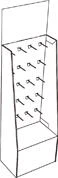
















A cardboard display is not printed like an ordinary shipping carton. It usually carries a brand logo, campaign color, product image, promotional message, and sometimes large blocks of solid color that need to stay consistent from sample to mass production.
For retail brands, this matters. A snack brand may rely on a strong red background. A beverage brand may need its blue to match the bottle label. A cosmetic brand may use soft pastel tones where even a slight shift can change the visual feeling of the display.
That is why printing method matters when producing custom printed cardboard displays. Before placing an order, buyers need to understand the difference between spot color, CMYK, Pantone matching, digital printing, flexo printing, and litho laminated printing. These choices affect color accuracy, cost, lead time, and the final retail presentation.
This guide explains how cardboard display printing works from a practical B2B buyer's perspective.
Why Printing Method Matters for Cardboard Displays
A retail display needs to be seen quickly. It often sits in a supermarket aisle, checkout area, promotional zone, or retail endcap where shoppers only give it a few seconds of attention.
Unlike inner packaging, a cardboard POP display usually has a much larger visual surface. The header, side panels, shelf lips, and base wrap all become part of the brand message. If the printing looks dull or inconsistent, the entire display loses impact.
Printing method affects several things:
- how accurately the brand color appears
- how sharp the logo and product image look
- how stable the color remains across a production batch
- whether the display is suitable for short-run testing or mass production
- how much the project costs
For brands planning a retail rollout, color control is not only a design issue. It is part of production planning.
What Is Spot Color Printing in Cardboard Display Production?
Spot color printing uses a specially mixed ink to reproduce a specific color. In many cases, the color is matched to a Pantone reference. Instead of creating a color by mixing CMYK dots on the printed surface, spot color uses a pre-mixed ink formula.
This is why spot color printing for cardboard display projects is often preferred when the display contains:
- brand logos
- large solid color backgrounds
- corporate identity colors
- simple graphic blocks
- repeat orders requiring color consistency
For example, if a brand's main color is a very specific orange or blue, spot color can help maintain a more stable result across a production batch. This is especially important for displays used in multiple stores, where inconsistent colors can make the brand presentation look uneven.
Spot color is not always necessary. It works best when color accuracy is more important than complex image reproduction.
Pantone vs CMYK for Cardboard Display Printing
Many buyers ask whether Pantone or CMYK is better. The answer depends on the artwork.
When Pantone or Spot Color Works Better
Pantone color matching is useful when the display needs to reproduce a brand color with higher consistency. It is a strong choice for:
- logos
- simple brand graphics
- bold background colors
- limited color palettes
- chain-store retail campaigns
- repeat production orders
For Pantone color matching for cardboard display projects, both customer and supplier should confirm the Pantone number before sampling. The approved sample then becomes the physical reference for mass production.
When CMYK Printing Works Better
CMYK printing for cardboard displays is more suitable for designs with:
- product photos
- gradients
- lifestyle images
- multi-color campaign graphics
- complex backgrounds
- photo-heavy promotional panels
CMYK can create a wider range of image effects, but it may not match some brand colors as consistently as spot color. For a display with both brand colors and product photos, a combined approach may be used: spot color for the logo or background, CMYK for images.
How Cardboard Material Affects Final Printed Color
The same ink does not look identical on every material. This is one of the most overlooked parts of corrugated display printing.
A cardboard display may use coated paper, gray-backed board, white-backed board, corrugated board, or paper mounted onto corrugated material. Each surface affects color differently.
Several factors matter:
- Paper whiteness: A warmer or grayer base can make colors look less bright.
- Ink absorption: More absorbent paper can make colors appear softer or darker.
- Surface smoothness: Rougher surfaces reduce image sharpness.
- Lamination: Gloss film can make colors look brighter; matte film can make them look softer.
- UV coating: Spot UV can create contrast, but it also changes how light reflects from the surface.
This is why a color that looks perfect on a smooth paper proof may appear slightly different after mounting onto corrugated board. For a high-visibility cardboard display, the material and surface finish should be confirmed before final color approval.
Common Printing Methods for Custom Printed Cardboard Displays
Different printing methods fit different project needs. There is no single "best" option for every display.
Digital Printing for Cardboard Displays
Digital printing for cardboard displays is useful for small runs, fast samples, and market testing. It does not require traditional printing plates, so setup is faster.
It works well for:
- prototypes
- low-volume campaigns
- multiple artwork versions
- urgent samples
- regional promotions
The limitation is that color consistency may be harder to control across large production runs compared with offset or spot color printing.
Litho Laminated Cardboard Display Printing
Litho laminated cardboard display printing is widely used for premium retail displays. The artwork is printed on high-quality paper first, then laminated onto corrugated board.
It is suitable for:
large visual areas
detailed product images
high-quality retail graphics
supermarket and brand promotion displays
medium to large production runs
This method usually provides better image quality than direct corrugated printing.
Flexo Printing Cardboard Display Projects
Flexo printing cardboard display projects are often used for simpler graphics and cost-sensitive production. It is common in corrugated packaging and some display components.
It fits:
simple line graphics
limited color designs
large production quantities
lower visual complexity
Flexo is not usually the first choice for premium product photos or detailed retail graphics, but it can be practical for simpler display structures.
When Should Brands Choose Spot Color for Cardboard Displays?
Spot color is useful when the display needs strong brand recognition and color stability.
Brands should consider spot color when:
- the display uses a strict brand color
- the logo color must match packaging
- the design includes large solid color areas
- the campaign will be used across many stores
- the same display will be reordered later
- the product category depends heavily on shelf identity
This applies to many retail categories, including food, beverage, cosmetics, electronics accessories, toys, and gift products.
For example, a beverage brand launching a promotional cardboard point of sale display may need the display background to match its packaging color. In that case, spot color or Pantone matching can be more reliable than relying only on CMYK.
Artwork and Proofing Tips Before Cardboard Display Printing
Good printing starts before production. Artwork mistakes often create bigger problems than the printing method itself.
Before producing custom printed cardboard displays, buyers should check:
- Is the artwork built in CMYK mode?
- Are Pantone colors clearly marked?
- Are images high enough resolution?
- Is the dieline correct?
- Is bleed included?
- Are fonts outlined or embedded?
- Are all file versions final?
- Is the surface finish confirmed?
- Is a color proof required?
A color proof for cardboard display production is especially important when brand color accuracy matters. A digital proof can help check layout, but a physical proof is better for judging real printed color. For high-value projects, a pre-production sample using the final material and finish is the safer option.
How to Choose the Right Printing Option for Your Cardboard Display Project
The right choice depends on artwork, order quantity, color requirements, and budget.
|
Project Need |
Recommended Printing Option |
|
Strict brand color |
Spot color / Pantone matching |
|
Product photos and gradients |
CMYK printing |
|
Small batch sample |
Digital printing |
|
Premium retail graphics |
Litho laminated printing |
|
Simple graphics and cost control |
Flexo printing |
|
Multi-store rollout |
Spot color + approved physical sample |
|
Multiple regional versions |
Digital printing or hybrid planning |
For most cardboard display projects, the best result comes from discussing the display structure, material, artwork, printing method, and surface finish together. Treating printing as the last step usually creates unnecessary risk.
Why Brand Color Consistency Matters in Retail Displays
A retail display often sits next to competing products. Its color needs to be recognized quickly.
Brand color consistency helps with:
- faster product recognition
- stronger shelf blocking
- better campaign consistency
- more professional in-store presentation
- smoother repeat orders
For brand color consistency in retail displays, printing should be planned as part of the display development process. The supplier should understand whether the project needs exact brand color control, photo-quality graphics, short-run flexibility, or cost-efficient production.
That decision affects the entire project, from artwork preparation to sampling and mass production.
Final Thoughts
Spot color, CMYK, Pantone matching, digital printing, flexo, and litho lamination all have their place in cardboard display printing. The best option depends on what the display needs to achieve.
Use spot color when brand color consistency is critical.
Use CMYK when the design relies on photos, gradients, or complex images.
Use digital printing for samples, small batches, or fast testing.
Use litho lamination when the display requires high-quality retail graphics.
Use flexo when the design is simpler and cost efficiency matters.
A well-planned cardboard display project should consider printing method before production begins. Clear artwork, confirmed color references, physical proofing, and consistent materials all help create a better final display.
For brands ordering custom printed cardboard displays, the goal is not just to make the display look attractive. The goal is to make the printed display match the brand, support the campaign, and perform well in the real retail environment.
FAQ
1.Is spot color printing better than CMYK for cardboard displays?
Spot color is usually better for strict brand colors, logos, and large solid color areas. CMYK is better for photos, gradients, and complex multi-color artwork.
2.When should I use Pantone colors for a cardboard display?
Use Pantone colors when the display includes important brand colors, large color blocks, or multi-store campaigns where color consistency matters.
3.Can cardboard display printing match my brand color exactly?
A supplier can get very close when Pantone references, physical samples, final material, and surface finish are confirmed. Exact results depend on paper, ink, finish, and production conditions.
4.What printing method is best for custom printed cardboard displays?
It depends on the project. Digital printing is good for samples, litho lamination is good for premium graphics, flexo is practical for simple graphics, and spot color is better for brand color control.
5.Why does the same color look different on corrugated cardboard?
Corrugated board, paper whiteness, ink absorption, lamination, coating, and lighting all affect the final printed appearance. This is why material confirmation and physical proofing are important.