









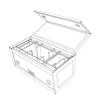



Retail environments operate on precision. Products arrive, move through distribution, reach shelves, and are expected to perform immediately. Packaging plays a direct role in whether that process functions smoothly or creates friction. For brands working with physical retail, retail packaging must support logistics, merchandising, and sales at the same time.
Retail-ready packaging is not a design trend. It is a working system used by retailers to reduce handling time, control labor costs, and keep shelves stocked consistently. When packaging does not meet these standards, products are delayed, misplaced, or removed from planograms.
This article outlines six practical elements required for retail-ready packaging and how cardboard display systems support those requirements in modern retail operations.
What Is Retail-Ready Packaging
Retail-ready packaging refers to packaging formats designed to move directly from shipping to shelf placement with minimal handling. These systems allow retail staff to place products on display without unpacking individual units. Most retail-ready formats are based on corrugated materials due to weight limits, recyclability, and cost control.
Cardboard point of sale display formats are commonly used within retail-ready systems. These include shelf trays, countertop units, and floor-based cardboard display racks designed for fast deployment.
Retail-ready packaging is used across grocery, personal care, electronics accessories, seasonal products, and promotional goods.

Why Retail Packaging Standards Matter
Retailers manage large volumes of inbound inventory. Packaging that slows stocking or creates confusion increases labor costs. For this reason, many retailers define strict packaging specifications related to size, labeling, palletization, and shelf presentation.
Retail packaging that aligns with these standards improves acceptance rates and reduces manual adjustments at the store level. For suppliers, meeting these requirements improves reorder consistency and long-term placement stability.
Cardboard display suppliers often work directly with brand teams to align packaging formats with retailer guidelines before production begins.
Structural Compatibility
Structural design determines whether packaging performs its intended function in-store. Packaging must support product weight, stacking, and repeated handling without deformation.
Corrugated retail displays are commonly engineered with reinforced bases, internal dividers, and controlled opening points. These features allow products to remain organized after partial depletion.
For countertop and shelf placement, cardboard display racks must fit predefined shelf depths and height restrictions. Structural mismatch often leads to rejected displays or forced repacking at the store level.
Retail Compliance Requirements
Retail compliance includes specifications related to pallet size, barcode placement, labeling format, and opening instructions. Packaging must arrive store-ready, meaning it can be placed on the sales floor without tools.
Retail-ready packaging often includes tear-away panels, perforated lids, and visual cues indicating correct opening procedures. These features reduce stocking time and prevent damage caused by box cutters.
Experienced cardboard display suppliers design packaging systems that meet multiple retailer standards simultaneously to support multi-channel distribution.

Product Size and Placement Logic
Product dimensions influence display format selection. Smaller items are commonly placed in countertop or shelf-level displays, while higher-volume products may require freestanding units.
Cardboard display racks are designed around unit count, replenishment frequency, and shopper reach zones. Poor alignment between product size and display type reduces sell-through efficiency.
Retail-ready packaging must also consider transport stability. Displays should maintain integrity from warehouse to store without requiring repacking or reinforcement.
Brand Identification Consistency
In physical retail, packaging often serves as the primary brand identifier. Retail packaging must clearly communicate brand ownership, product category, and usage context within limited visual space.
Cardboard point of sale display systems allow for consistent branding across multiple formats, including shelf trays and counter units. Visual consistency improves recognition across locations and product lines.
Brand elements must remain legible even as inventory levels decline throughout the sales cycle.
Shopper Interaction Expectations
Retail-ready packaging must support easy product access. Shoppers should be able to remove items without disturbing the display structure.
Countertop displays are frequently used for small, impulse-driven items. These displays rely on stable bases and clear product presentation to maintain order during high interaction periods.
Corrugated retail displays are designed to balance accessibility with containment, ensuring products remain visible without falling or shifting.

Setup, Removal, and End-of-Life Handling
Retail-ready packaging is designed for efficiency beyond initial setup. Displays are often deployed for limited-time promotions, seasonal programs, or product launches.
Retail-Ready Packaging are favored for their lightweight structure and recyclability. After use, displays can be broken down quickly without tools and processed through standard recycling streams.
This efficiency reduces backroom storage needs and aligns with retailer sustainability goals.
Retail-ready packaging operates at the intersection of logistics, merchandising, and brand presentation. Cardboard display systems continue to be a practical solution for brands seeking flexibility, scalability, and compliance across retail environments.
When retail packaging is designed with structure, placement, and operational flow in mind, it supports not only product visibility but long-term retail relationships.